

How Traditional Souk Crafts Are Passed From Masters to Apprentices
In a narrow workshop deep inside Marrakech Medina, a master craftsman bends over a piece of metal. Beside him, a younger worker watches the movement of his hands. The master measures, adjusts his tool and makes a careful strike. Then he passes the work to the learner, who attempts the same movement. The first result may be imperfect. The lesson continues.
This simple exchange reveals something that visitors often overlook in the Marrakech souks: the traditional crafts are not preserved only through objects. They survive through people teaching other people.
For generations, experienced Moroccan artisans have passed practical knowledge to apprentices through observation, repetition, correction and years of work. The lessons take place in workshops, family businesses and specialist craft quarters rather than exclusively in classrooms.
At Visit Marrakech Medina, we believe these relationships are among the most important stories of the old city. A lantern, a carved wooden box or a pair of leather slippers becomes more meaningful when you understand the skill required to make it and the person who taught the maker.
To discover the working souks with a local guide, explore our private Marrakech Medina walking tour or our Marrakech souks shopping experience. Contact us through our booking form or on WhatsApp.
What Is a Maalem in Moroccan Craftsmanship?
In Morocco, the word maalem, also written mâalem or maâlem, is commonly used for a master craftsman: someone whose expertise has been developed through extensive practical experience.
A maalem is more than a person who knows how to operate tools. A skilled master understands the behavior of materials, the correct order of production, the quality expected from a finished object and the mistakes that can occur during each stage.
The master may also understand how to estimate costs, select suppliers, deal with customers and organize workshop production.
Not every experienced artisan teaches apprentices, and not every workshop follows the same system. But where traditional apprenticeship survives, the maalem often plays a central role in transmitting the craft.
Our article about the hidden masters who keep Marrakech alive introduces the people behind these occupations.
Why Apprenticeships Matter to the Marrakech Souks
Marrakech developed as an important trading and craft center after its foundation in the eleventh century. Merchants, builders and residents needed metal tools, wooden fittings, leather goods, textiles, pottery and many other products.
As commercial activity grew, different occupations became associated with particular streets and market areas. This organization allowed craftsmen to work near suppliers and others practicing similar trades.
It also created an environment where younger workers could learn from experienced artisans.
Learning a craft meant more than memorizing instructions. It required developing the ability to judge materials, recognize faults, control tools and produce reliable work repeatedly.
These skills were difficult to acquire through observation alone. They demanded practice and feedback from someone with experience.
For historical context, read our article about the Medina's role in Moroccan trade and culture and our essential guide to Marrakech's souks.
1. The First Lesson: Watching Before Making
Traditional apprenticeship often begins with observation.
A newcomer watches how the master prepares the workbench, chooses tools, handles materials and approaches a task. What may look effortless is usually the result of years of experience.
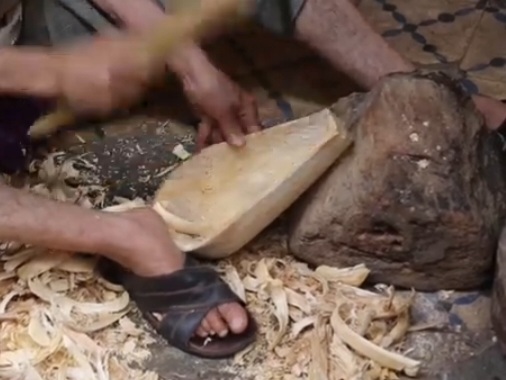
A metalworker knows how much force to apply. A woodcarver recognizes the direction of the grain. A leatherworker understands how a hide stretches. A weaver notices when the tension of the threads is wrong.
These judgments cannot always be reduced to a simple written formula.
By watching the master repeatedly, the learner begins to recognize patterns: which movements are deliberate, which measurements matter and which signs indicate a problem.
Observation is therefore active learning, even when the apprentice has not yet been trusted with the most difficult work.
2. Learning the Workshop's Everyday Routine
Before producing a finished object, an apprentice may learn to prepare materials, organize tools, clean the work area and assist with simple tasks.
These responsibilities might seem unimportant to an outsider, but they introduce the rhythm of the workshop.
The learner discovers which tools must be kept sharp, which materials require careful storage and why preparation affects the quality of the finished piece.
In a woodworking workshop, the condition of a cutting edge matters. In leatherworking, the arrangement of patterns can reduce waste. In metalwork, securing the material correctly improves both precision and safety.
Good craftsmanship begins before the decorative work starts.
For a closer look at these environments, explore our artisans of the Medina workshop tour.
3. Repetition: The Foundation of Traditional Skill
One of the defining features of craft apprenticeship is repetition.
A learner may practice the same cut, stitch, knot or hammer movement many times before being given more demanding work.
Repetition develops control, consistency and familiarity with tools.
For example, a metalworker learning to pierce decorative patterns must develop a steady hand. The spacing of the holes affects the appearance of the finished lantern.
A leatherworker must learn to cut pieces accurately so that the final object fits together properly.
A woodcarver needs to understand how a tool responds to different grain directions.
The goal is not merely speed. It is the ability to produce dependable results without wasting materials.
Progress varies by craft, by individual and by workshop. There is no single apprenticeship timetable that applies to every Marrakech artisan.
4. Correction: How a Master Teaches Without a Textbook
In many practical crafts, a small mistake can teach an important lesson.
A cut may be too deep. A seam may be uneven. A metal edge may be poorly finished. A woven section may have inconsistent tension.
An experienced master can often identify the problem quickly and explain what caused it.
Sometimes the explanation is verbal. Sometimes the master demonstrates the movement again and asks the apprentice to repeat it.
This combination of correction and practice is central to learning by doing.
It also teaches the learner to inspect their own work rather than relying on someone else to find every defect.
5. When Does an Apprentice Become a Master?
There is no universal number of years that automatically turns an apprentice into a maalem.
The time required depends on the complexity of the trade, the opportunities to practice, the learner's progress and the standards expected in the workshop.
A learner may become competent at one operation long before mastering the complete production process.
For example, being able to stitch part of a leather bag does not necessarily mean being ready to design, cut, assemble and finish an entire product independently.
Mastery involves planning the work, selecting materials, solving problems and judging the quality of the result.
In some traditions, recognition comes through the confidence of other craftspeople, customers and the wider professional community rather than through a single formal certificate.
6. Metalworking Apprenticeships in Souk Haddadine
Souk Haddadine is historically associated with blacksmiths and metalworkers.
In a metalworking workshop, a learner may begin by understanding the different tools and materials before attempting complicated decorative work.
Depending on the workshop, the craft can involve measuring, cutting, bending, hammering, piercing, joining and finishing metal.
Each stage requires different judgments.
A master knows how the material responds to pressure and how an error early in production can affect the finished object.
Decorative lantern-making provides a useful example. A learner must understand not only the pattern but also the structure of the object and the relationship between its different components.
Visitors who see a finished lantern often notice its beauty first. The apprenticeship story reveals the patient technical work behind it.
Read more about the artisans in our guide to Marrakech's master craftsmen.
7. Woodcarving: Learning to Read the Material
Woodworking requires a different kind of sensitivity.
Wood is not perfectly uniform. Its grain, hardness and condition influence how it can be cut and shaped.
A master woodworker teaches the learner to recognize these differences before attempting delicate carving.
In areas associated with traditional woodcraft, including Souk Chouari and other artisan lanes, workshops may produce furniture, boxes, decorative panels and household objects.
Training can include measuring, sawing, joining, carving, smoothing and finishing.
With experience, the apprentice learns that a decorative design must work with the material rather than against it.
To discover more about the specialized market streets, read the hidden souks most tourists miss.
8. Leatherworking: From Simple Stitches to Finished Products
Leathercraft is another traditional occupation closely associated with Marrakech.
Leatherworkers may produce bags, belts, slippers, poufs and other practical or decorative objects.
An apprentice needs to learn how different types of prepared leather behave, how to position patterns and how to cut pieces efficiently.
Stitching and assembly require patience because small inaccuracies can become visible in the finished product.
Training may also include selecting linings, attaching fastenings and finishing edges.
Leatherworking should not be confused with tanning, which is the separate process of preparing hides for use.
For travelers interested in the quality and origin of traditional goods, our authentic Marrakech handicrafts guide provides further information.
9. Babouche Making: Small Objects, Precise Skills
Traditional Moroccan slippers, known as babouches, provide an excellent example of a craft that looks simple until you examine the production process.
The maker must consider the shape of the slipper, the material, the sole, the seams and the way the different pieces fit together.
A learner may begin with preparation or stitching before progressing to cutting and assembling complete pairs.
Consistency is important: two slippers must belong together in size, shape and finish.
Traditional footwear also illustrates how everyday objects can carry cultural knowledge. Designs change over time, but the skills required to make a well-finished pair remain valuable.
Discover more examples in our Marrakech Medina shopping guide.
10. Weaving: Learning Rhythm, Tension and Pattern
Textile crafts require careful coordination between hands, tools and materials.
A learner must understand how threads interact, how tension affects the fabric and how patterns develop through repeated movements.
Weaving traditions vary considerably across Morocco. Many rugs sold in Marrakech originate in other regions, including Amazigh communities where weaving knowledge has often been transmitted within families and between generations of women.
It would be inaccurate to describe every rug sold in the Marrakech souks as having been woven inside the Medina.
What connects these traditions is the importance of practical knowledge.
A skilled weaver can recognize tension problems, adjust the structure and maintain consistency across a large textile.
For visitors interested in understanding rug origins and craftsmanship, explore our Marrakech shopping tour guide.
11. The Dyers: Passing on Knowledge of Color
Traditional textile dyeing requires knowledge of fibers, color preparation, timing and the behavior of different materials.
In Marrakech, the historic dyers' souk preserves the memory of this specialized trade.
An experienced dyer understands that the appearance of a color can depend on the fiber, the dye, the preparation process and other conditions.
A learner must develop the ability to observe these changes and achieve consistent results.
Not every colorful yarn display in the souks represents an active dyeing workshop, and not all modern textiles use traditional natural dyes.
Nevertheless, the historic trade shows how specialized knowledge can be transmitted through practical instruction.
Our register of the last artisans of Marrakech Medina discusses the challenges facing traditional dyers and other crafts.
12. Pottery and Ceramics: Learning Through the Hands
Pottery combines technical knowledge with physical coordination.
A potter must understand the properties of clay, the preparation of the material, shaping, drying, firing and finishing.
A beginner may struggle to maintain the shape of an object because the clay responds immediately to pressure.
With practice, the hands become more controlled and the maker learns how much force to apply.
Decorative painting introduces additional skills, including brush control, pattern planning and consistent application.
Not all pottery sold in Marrakech is made in the city. Morocco has several important ceramic production centers, and the Medina also functions as a marketplace for products made elsewhere.
Understanding the origin of a piece is part of appreciating its craftsmanship.
13. Jewelry Making: Precision on a Small Scale
Traditional jewelry making involves working with small components and demanding details.
Depending on the type of jewelry, an apprentice may learn measuring, shaping, soldering, engraving, polishing and assembling.
Errors that would be minor on a large object can be highly visible on a small piece.
Masters teach not only how to create decorative forms but also how to make an object strong enough for regular use.
Moroccan jewelry traditions vary by region and community. A design sold in Marrakech may reflect techniques and styles developed elsewhere in the country.
Visitors interested in the wider range of traditional products can consult our souk-by-souk shopping guide.
14. The Role of Family in Traditional Craft Training
Many Moroccan craft businesses have been family enterprises, and knowledge has often passed between parents, children and other relatives.
A child growing up around a workshop may become familiar with its tools, sounds and daily routines long before choosing a profession.
However, family transmission is not the only form of apprenticeship.
People can learn from masters outside their families, and not every artisan's child wants to continue the same trade.
Modern education, changing career opportunities and economic pressures all influence these decisions.
The survival of a craft therefore depends on more than preserving a family name. It depends on whether the next generation has a realistic opportunity to learn and earn a living from the work.
15. What the Old Craft Guilds Contributed
Historically, specialized craft communities and professional associations helped organize aspects of production and commercial life in Moroccan cities.
The term taifa is associated with traditional occupational groups.
These structures could help maintain professional relationships, transmit skills and establish expectations within a trade.
However, the historical organization of guilds changed over time, and modern Marrakech workshops should not all be assumed to operate under an unchanged medieval system.
The important legacy is the relationship between craft specialization, community knowledge and training.
For more historical background, explore our complete traveler's guide to Marrakech Medina.
16. What Apprentices Learn Beyond Technical Skills
Traditional craftsmanship is also a business.
An apprentice who hopes to become independent needs to understand materials, suppliers, costs, customer expectations and the time required to complete an order.
Masters may teach how to recognize poor-quality supplies, avoid unnecessary waste and decide whether a product is ready to sell.
There are also professional habits to learn: arriving reliably, protecting tools, communicating clearly and taking responsibility for mistakes.
These skills matter because the reputation of a workshop depends on the consistency of its work.
A beautiful object is only one part of a successful craft business.
17. Why Some Traditional Apprenticeships Are Disappearing
Not every craft in Marrakech is attracting enough new learners.
Some younger people prefer careers that offer more predictable income, less physically demanding work or better opportunities for advancement.
Traditional workshops may struggle with rising costs, limited space and competition from inexpensive factory-made goods.
Apprenticeship can also be financially difficult when the learning period is long and early earnings are limited.
These pressures vary by trade. Some crafts continue to attract new workers, while others face serious challenges.
The issue is not simply that young people have lost interest in tradition. They must also be able to build sustainable livelihoods.
Our Last Artisans of Marrakech Medina project documents the changing situation of several traditional occupations.
18. Can Modern Technology Help Preserve Traditional Crafts?
Traditional methods and modern technology do not have to be enemies.
A craftsman can preserve hand skills while using digital tools to communicate with customers, manage orders or document designs.
Online platforms may help small workshops reach buyers beyond the Medina.
Photographs and videos can record techniques for future generations, although they cannot fully replace supervised practical experience.
New equipment may also improve safety or efficiency in certain stages of production.
The central question is whether technology supports the artisan's expertise or replaces the skill that gives the work its distinctive character.
Read more about the relationship between tradition and change in Old and New Marrakech.
19. How Can Visitors Recognize a Genuine Working Workshop?
Visitors often ask how to distinguish a working artisan workshop from a shop that only resells finished products.
There is no perfect test, but the production environment can provide useful clues.
- Tools appropriate to the craft are present and appear to be used.
- Materials and unfinished pieces show different stages of production.
- The maker can explain how the object is produced.
- Small differences between handmade pieces may reflect individual workmanship.
- The workshop's activity matches the products being discussed.
However, a clean shop is not proof of factory production, and a workshop with tools is not automatic proof that every item for sale was made there.
Some genuine artisans sell through separate retail spaces.
The best approach is to ask respectful questions and avoid judging authenticity from appearance alone.
Our guide to avoiding tourist traps in Marrakech's souks offers further practical advice.
20. Can Tourists Watch Masters Teaching Apprentices?
Sometimes visitors can observe artisans working together, but apprenticeship is not a scheduled tourist performance.
A master may be concentrating on an order, and an apprentice may be handling a task that requires attention.
Access to workshops depends on the people working there and their willingness to welcome guests.
Always ask permission before entering or photographing anyone.
Do not touch tools or materials without an invitation.
If a workshop is busy, a brief respectful visit may be more appropriate than a long conversation.
For a deeper introduction to craft areas, see our deep-dive walking tour through Marrakech Medina.
21. What Questions Should You Ask an Artisan?
A few thoughtful questions can make a workshop visit more meaningful.
- How did you first learn this craft?
- Who taught you the most important techniques?
- Which part of the work takes the longest to master?
- What is the most common mistake beginners make?
- Where do your materials come from?
- Do younger people still want to learn this trade?
- How has the work changed during your career?
Not every artisan will have time to answer, and some may prefer to focus on their work. Respectful curiosity is more valuable than demanding a demonstration.
22. Why Buying Handmade Products Can Support Apprenticeship
When customers purchase genuinely handmade goods at sustainable prices, they can help create demand for skilled work.
That demand may make it easier for workshops to continue operating and train new workers.
However, buying an object does not automatically guarantee that the maker receives a fair share of the price.
It is worth asking who made the product and whether the shop works directly with the artisan.
Visitors should also remember that supporting traditional crafts does not require buying something they do not want.
Learning about the work, speaking respectfully about the artisans and sharing accurate information can also help raise awareness.
For practical shopping context, read our guide to shopping in Marrakech's traditional markets.
23. The Difference Between Preserving a Craft and Freezing It in Time
Traditional craftsmanship is often described as something that must remain exactly as it was centuries ago.
But living traditions have always adapted.
Artisans respond to new materials, changing tastes, different customers and practical economic conditions.
A woodworker may produce contemporary furniture using traditional joinery. A metalworker may adapt an established technique to a new lighting design. A textile maker may experiment with colors while retaining hand-weaving skills.
The essential question is not whether every product looks old.
It is whether the maker understands and continues the knowledge that gives the craft its quality and identity.
Preserving craftsmanship means keeping the skills alive in the hands of working people.
24. Why Marrakech's Workshops Are Living Classrooms
A traditional workshop is a place of production, but it can also be a place of learning.
Tools, materials, finished objects and mistakes all become part of the teaching process.
The master demonstrates what experience has taught. The apprentice develops skill through observation and repeated practice.
Over time, the learner may become capable of completing an entire object independently.
One day, that former apprentice may teach someone else.
This is how a practical tradition can continue without relying entirely on written instructions.
The knowledge survives because it remains useful, practiced and shared.
Our article Why Walking Is the Best Way to Know Marrakech explores the value of observing everyday life on foot.
25. Discover the Masters and Apprentices on a Marrakech Walking Tour
Visitors interested in traditional crafts can learn a great deal by walking through the specialized souks with a knowledgeable local guide.
A guide can explain the historic organization of the markets, the relationship between different trades and the distinction between workshops and retail shops.
Depending on access and the artisans' availability, a visit may include opportunities to observe traditional work.
At Visit Marrakech Medina, our aim is to introduce travelers to the culture and daily life of the old city without compulsory shopping.
Our Marrakech walking tours offer different ways to discover the Medina, while our artisan workshop experience focuses on traditional crafts.
If you prefer a broader cultural itinerary, see our ultimate walking tour through the old city.
Frequently Asked Questions About Traditional Craft Apprenticeships in Marrakech
What is a master craftsman called in Morocco?
A master craftsman is commonly called a maalem. The term recognizes practical expertise and professional skill developed through experience.
How do artisans learn traditional crafts in Marrakech?
Many learn through practical training with experienced craftspeople, combining observation, simple tasks, repetition and increasingly complex work.
Are traditional crafts always passed from father to son?
No. Family transmission is important in some trades, but people also learn from masters outside their families. Women are central to several Moroccan textile and craft traditions.
How long does a traditional apprenticeship last?
There is no fixed duration for every craft. The learning period depends on the trade, the complexity of the work and the apprentice's progress.
What is the difference between an apprentice and a maalem?
An apprentice is learning the trade. A maalem is an experienced craftsperson capable of handling demanding work and, in some cases, teaching others.
Where can I see traditional metalworkers in Marrakech?
Souk Haddadine is historically associated with blacksmiths and metalworkers. Workshop activity varies from day to day.
Where can I find traditional woodworkers?
Souk Chouari and other artisan streets are associated with woodworking, although individual workshops and their activities may change.
Are Moroccan rugs woven in Marrakech Medina?
Some textile work takes place in the city, but many rugs sold in Marrakech are woven elsewhere in Morocco, including in Amazigh communities with their own weaving traditions.
Are apprenticeships disappearing?
Some crafts face difficulties attracting new learners because of economic pressures and changing career opportunities. Other trades remain active and continue to train workers.
Can visitors enter an artisan workshop?
Some workshops welcome visitors, but entry is never guaranteed. Always ask permission and respect the artisan's work.
Do I need to buy something during an artisan visit?
No. Cultural discovery and shopping are separate choices. Visitors can appreciate traditional craftsmanship without making a purchase.
How can travelers support traditional Moroccan crafts?
They can learn about the makers, share accurate information, respect workshop practices and, when they choose to buy, consider products with clear origins and genuine workmanship.
Can I book a private Marrakech tour focused on traditional artisans?
Yes. Contact Visit Marrakech Medina to discuss a private walking experience focused on craft quarters, historic souks and traditional workshops, subject to access and availability.
The Future of Marrakech's Crafts Depends on the Next Generation
When visitors admire a Moroccan lantern, a carved wooden box or a handmade leather bag, they usually see the finished object.
What they may not see is the long process of learning behind it.
Someone once taught the maker how to hold the tool, judge the material, recognize a mistake and finish the work properly.
That knowledge may have passed through several generations of masters and apprentices before reaching the workshop of today.
The future of Marrakech's traditional crafts depends not only on preserving historic streets or displaying beautiful objects. It depends on making it possible for skilled artisans to continue working and for new learners to develop the same expertise.
The souks are therefore more than places of commerce. They are places where cultural knowledge is practiced, challenged, improved and passed on.
To explore this side of Marrakech, book our private Marrakech Medina walking tour or discover the traditional souks with a local guide.
Ready to discover the artisans behind Marrakech's famous handicrafts? Contact us through our online booking form or send a message on WhatsApp at +212 614 905 398. Tell us your preferred date, group size and the crafts that interest you most. We will help you plan a respectful private visit through the living workshops and traditional markets of Marrakech Medina.