
Shopping Tour Marrakech: The Ultimate Guide to a Magical Market Experiences
Which souk sells what in Marrakech?
Each souk in the Marrakech Medina has its own craft. Souk Semmarine is the main street for textiles and souvenirs, Souk Cherratine is for leather, Souk Haddadine for metal and lanterns, Rahba Kedima for spices and baskets, Souk Smata for babouches, and the dyers' souk for freshly colored wool. Knowing which souk sells what saves you hours and helps you buy from the real makers. Want a local to take you straight to the right ones? Message Us On WhatsApp or use our Booking Form.
The souks of Marrakech work a bit like a giant department store, except there's no floor plan, no escalator, and every department insists it's the best one. Once you know where each craft lives, the maze suddenly starts to make sense.
Visit Marrakech Medina, The Best Shopping and Walking Tour Company in Marrakech, has been guiding travelers through the souks since 2004. We're Recommended By Rick Steves, and our Medina walk was featured by Daniel Jacobs in The Rough Guide To Morocco.
Choose your tour
How Long Does A Walking Tour Of The Medina Take? The Medina, its history and hidden corners, with or without shop stops.
How Do You Bargain In The Marrakech Souks? The souks with an insider, straight to the real artisans.
Are Moroccan Rugs Cheaper In Marrakech? Styles, quality checks, fair prices and shipping home.
Is There A Luxury Shopping Tour In Marrakech? Master artisans, designer boutiques and a private, discreet service.
What To Do In Marrakech On A First Visit? Everything worth your time beyond the Medina.
How are the souks of Marrakech organized?
For centuries, each craft had its own street. Metalworkers worked side by side, leather workers had their lane, spice sellers had their square. Neighbors in the same trade kept each other honest, and buyers knew exactly where to go. Much of that order still survives today, even if souvenir shops now appear everywhere.
The simple way to picture it. The souks start just north of Jemaa el-Fna, and the further north you walk, the older and more traditional they become. Want to reach that oldest part without getting lost? See How Do You Reach The Oldest Part Of The Medina?
The souks, one by one
Souk Semmarine, the main street
The wide covered street that starts near Jemaa el-Fna and runs north into the souks. Textiles, babouches, lanterns, souvenirs and clothes. It's the easiest place to start, and also the busiest, so compare before you buy. Curious about it? See What Is The Main Souk Street In Marrakech?
Rahba Kedima, the spice square
A small open square off Souk Semmarine, with pyramids of spices, dried herbs, handwoven baskets and straw hats. The herbalists here also sell natural remedies, argan oil and black soap for the hammam.
Souk Cherratine, the leather souk
The lane of leather workers, with bags, belts, wallets, poufs and jackets. Look at the stitching and the inside of a bag, not only the outside. Good leather smells natural, never of chemicals.
Souk Smata, the babouche souk
Hundreds of babouches in every color, from simple yellow leather to embroidered pairs for women. The traditional yellow ones are the most authentic.
Souk Haddadine, the blacksmiths
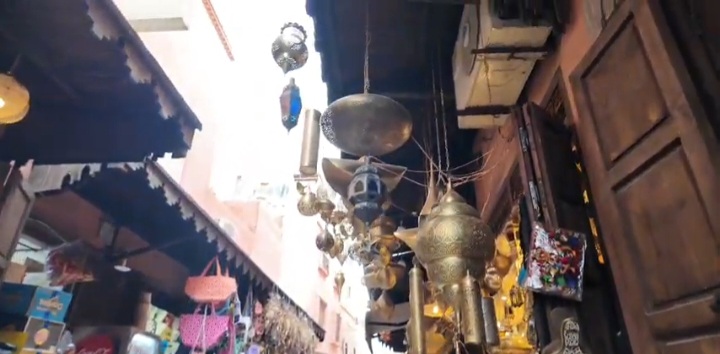
You'll hear it before you see it. Metalworkers hammer lanterns, lamps, trays and door knockers by hand. It's one of the most impressive souks to watch, and one where real artisans still work in front of you. Want to meet them? See Who Are The Last Artisans Of The Marrakech Medina?
Souk Chouari, the woodworkers
The smell of cedar fills the lane. Carpenters and woodturners make boxes, chess sets, spoons and furniture, some still turning wood on a lathe they push with their foot.
The dyers' souk
Near the Mouassine quarter, skeins of freshly dyed wool hang above the lane in deep blue, red and saffron yellow. Come in the morning, when the colors are freshest. See Where Is The Dyers Souk In Marrakech?
The rug souks
Around Rahba Kedima, in the area known as the Criée Berbère, rug shops display carpets and kilims from every region of Morocco. It's the best place to compare styles, but also where knowing quality and fair prices matters most.
The jewelry souks
Near Souk Semmarine, jewelers sell gold, while silver and Berber jewelry are found in smaller shops across the souks and in the old Mellah quarter.
Souk Ableuh, the olive souk
Close to Jemaa el-Fna, stalls piled with green, black and violet olives, preserved lemons and harissa. A great stop for a taste of local life.
The tanneries, near Bab Debbagh
In the northeast of the Medina, near the gate of Bab Debbagh, leather is still treated in open-air pits. It's a working place, not a show, so go with a guide and expect a strong smell.
What Happens On A Real Tour With Us?
Anna & Mark, Ireland
"Really enjoyed this tour. We had been walking around the souks on our own the day before and honestly didn't know where to go. With our guide, everything made much more sense. We saw small workshops, learned about the different crafts and discovered parts of the Medina we would have missed. Very friendly and relaxed from beginning to end."
What Do Our Guests Usually Ask On The Tour?
Julia, Germany
"A lovely experience in Marrakech. What I appreciated most was that the tour was not rushed. We could stop, ask questions and take in the atmosphere. Our guide clearly knows the Medina very well and shared lots of interesting details about local traditions and daily life. It was a good balance between history, culture and seeing how people actually live and work today."
What Surprises Travelers Most On Our Walks?
Robert T., United States
"I recommend doing this early in your stay. Marrakech can be a little overwhelming at first, especially inside the souks, but this walk helped me understand the city and feel more comfortable exploring by myself afterwards. The small streets and artisan workshops were probably my favourite part. No pressure, no rushing, just a genuinely interesting walk with someone who knows the place well."
How do you shop well in the souks?
Look first, buy later. Walk through a souk once to compare quality and prices before choosing.
Ask where it's made. Real artisans are proud to tell you, and some will show you their workshop.
Bargain with a smile. Prices are rarely fixed, but there's no magic rule like "offer half". A fair price depends on the quality, so knowing what you're looking at matters more than any trick.
Carry cash. Most small shops don't take cards.
Never feel obliged. Drinking a tea or looking at rugs doesn't mean you have to buy.
When is the best time to visit the souks?
Mornings are calmer, and many artisans are already at work. Late afternoon is livelier, with locals shopping too. On Fridays, many shops pause around midday prayer. See Are The Souks Open On Friday?
Our shopping tour options and prices
Group tour with shopping (pay at the end, nothing upfront)
Tuesday, Thursday and Saturday at 10 am, 250 MAD per person, up to 10 people, from Café de France on Jemaa el-Fna. Looking for the most affordable option? See Is There A Cheap Walking Tour In Marrakech?
Private tours, about 3 hours, every day
1 to 2 people, 900 MAD
3 to 4 people, 1,200 MAD
5 to 6 people, 1,500 MAD
7 or more, on request
Tours run in English and French. For another language, ask before booking. In Marrakech for a short time? See Which Tours Are Available In Marrakech Today?
FAQ
What is the main souk in Marrakech?
Souk Semmarine, the covered street that starts near Jemaa el-Fna and leads north into the other souks.
Where is the leather souk in Marrakech?
Mainly around Souk Cherratine. The tanneries themselves are near Bab Debbagh, in the northeast of the Medina.
Where can I buy spices in Marrakech?
On Rahba Kedima, the spice square off Souk Semmarine, and in the Mellah.
Is the Chouara Tannery in Marrakech?
No, the famous Chouara Tannery is in Fes. Marrakech has its own tanneries near Bab Debbagh.
Do I need a guide for the souks?
Not to enter them, but a guide saves time, takes you to real artisans and helps you pay fair prices.
Ready to shop the souks like a local? Book On WhatsApp for a fast reply, or use our Booking Form.
Curious about the stories behind the souks' names? Read What Can't You Find In Other Marrakech Guides?
Who Wrote This Guide?
This guide was written by the local team of Visit Marrakech Medina, Marrakchis who were born and raised in the city and have guided travelers through the Medina since 2004. Our Medina walk is featured in The Rough Guide to Morocco, and our guiding is recommended by Rick Steves. Everything here comes from what we see and hear on our walks every day.
Have a question about your trip, even if you don't book a tour? Ask Us On WhatsApp. We're happy to help travelers plan their days in Marrakech.
Found this guide useful? Save it for your trip or share it with a friend who's heading to Marrakech.
Writing about Marrakech? Feel free to link to this guide, or contact us for local insights and photos.
Discover our full range of authentic Marrakech tours on our Visit Marrakech Medina homepage.