
Marrakech Unwritten
.jpeg)
.jpeg)
What do Marrakchis know about Marrakech that no guidebook tells you?
Guidebooks will tell you the Koutoubia is tall, the souks are busy and the mint tea is sweet. All true. But they won't tell you why the walls are red, what the holes in them are for, why a door has two knockers, or why a muezzin once rode a horse up a minaret. Marrakech Unwritten is the city as Marrakchis know it: stories passed from fathers, grandmothers, artisans and neighbors, collected over decades by locals who were born, studied, worked and raised their families here.
Want to hear them in person?
Message Us On WhatsApp or use our Booking Form.
Visit Marrakech Medina, The Best Shopping And Walking Tour Company In Marrakech, takes travelers into the real Medina: the workshops, the hidden doors and the stories behind every corner. Our guiding was recommended by Rick Steves and featured by Daniel Jacobs in The Rough Guide To Morocco, and we have guided some very well known clients (we never share names).

Hear these stories on the ground:
See this week's tours on Marrakech Tours This Week, and plan your visit with What Time The Souks Open And Close.
A small country inside a big city
The Medina of Marrakech is a small country inside a big city, inside a big country. It has its own streets, its own rhythm, its own rules, and a language of doors, walls and names that every Marrakchi reads without thinking.
Where Do These Stories Come From?
Most of what you'll read here isn't in any guidebook. It comes from Marrakchis who were born in this city, studied here, worked here and raised their families here, and from local guides who have walked the Medina every day for more than twenty years.
Some of these stories come from history books. Most come from somewhere else: a grandmother explaining why the walls are red, a baker who knows every family's bread, an old artisan telling how his street got its name, a neighbor arguing over tea about which version is the true one. This is the Marrakech that's passed on by word of mouth, from one generation to the next, and almost never written down. That's why we called this page Marrakech Unwritten.
King Hassan II once described Morocco as a tree whose roots go deep into the soil of Africa, and whose leaves breathe the winds of Europe. Nowhere do you feel that more than in the Medina, where Amazigh (Berber), Arab, Andalusian and African threads have been woven together for nearly a thousand years.
Part 1: Understanding Marrakech
Marrakech in three parts
Most visitors only hear of two: the Medina and Gueliz. In truth, Marrakech has three parts.
The Medina: the old walled city, with the souks, riads and monuments
Gueliz: the new city built during the French protectorate (1912 to 1956), upscale and expensive. Locals will tell you its name comes from the French word "Église," church, which Marrakchis pronounced "Gueliz"
The middle-class quarters: the biggest part of the city, with no single name, made of many neighborhoods built from the 1970s onward, like Daoudiate, home of the university, and Massira, the newest. This is where most Marrakchis actually live
The Marrakech most visitors see is only a small part of the real city.
Is Marrakech the capital of Morocco?
Many visitors think so. It was, centuries ago, but today the capital is Rabat. The very first capital of Morocco was Fez, founded in 789 by Moulay Idriss. Marrakech today is something else: the tourism capital of the country, and its most famous name abroad.
What does "Medina" really mean?
Most guidebooks translate medina as "old city." Today, in Morocco, that's what it means. But listen to the word the way an Arabic speaker hears it. Madina shares its root with tamaddana, to become civilized, to develop, and with tamaddun, civilization. A medina was the opposite of the village: the place of trade, learning, craftsmanship and new ideas. The Quran even calls Mecca "Umm al-Qura," the mother of villages.
English does exactly the same thing: "civilization" comes from the Latin word for city. So when you walk into the Medina of Marrakech, you're not entering the "old" part of town. You're entering what was, for centuries, the most modern place for hundreds of kilometers around.
How the Medina grew, like the rings of a tree
The Medina wasn't built all at once. It grew outward in circles, like the rings of a tree trunk. The heart, from the 11th and 12th centuries, lies around the Almoravid Koubba, where water carried from the Atlas Mountains by underground channels called khettaras first reached the city. Each dynasty added a new ring around it, all the way to Jemaa el-Fna. The ramparts moved with the city, built, destroyed and rebuilt, until the line you see today took shape, mostly in the 16th century.
Want to walk from the newest ring to the oldest? Follow The Secret Loop Marrakech Medina and its simple key to the souks, The H Rule.
Why is Marrakech red?
Marrakchis say red, not ochre, and there are three reasons:
The earth itself: the founders built with the soil they found on the spot, and that's its natural color
Your eyes: in a city this sunny, white walls would be blinding. The red earth absorbs the light and is gentler on the eyes, something every Marrakchi knows from living under that sun
A symbol: for the Amazigh people, red means life. In Europe, it often means danger. That's why red is everywhere in Moroccan rugs
The ramparts and the gates
The Medina is wrapped in about 19 kilometers of ramparts (guides give different numbers), around 3 to 4 meters high, renovated many times over the centuries and always kept in the color of the earth. Locals count nine main gates. The most beautiful, Bab Agnaou, actually stands inside the Medina, facing Bab Er-Rob, the southern gate toward the Atlas Mountains. Others include Bab Doukkala, Bab El Khemis, and Bab Jdid, next to the famous La Mamounia hotel.
What Does Bab Doukkala Mean?
In Arabic, bab means gate, a big one, the kind that guards a city. Marrakech is wrapped in ramparts pierced by many gates. Locals often speak of nine main ones, though the count changes depending on who you ask. Bab Doukkala is one of the most famous.
A gate named after a region
Doukkala is a region of Morocco, on the Atlantic plains west of Marrakech, around El Jadida. People from there are called Doukkali. It's an Arabic-speaking region, known for its strong, recognizable accent, quite different from the Amazigh (Berber) spoken in the Atlas Mountains. The gate is named after it because it faces west, toward Doukkala and the ocean.
A gate as old as the city's walls
Bab Doukkala goes back to the Almoravids, the founders of Marrakech, who wrapped their young city in high earth walls for protection, a bit like the ramparts of Troy. Later dynasties rebuilt and reinforced it, but the idea stayed the same: guard the city, control who comes in.
The door to the west
For centuries, Bab Doukkala was the way in for travelers and traders coming from the Doukkala plains and the Atlantic coast, carrying goods that had arrived from other countries by sea. Some sold their goods in Marrakech. Others only passed through, continuing toward the Atlas Mountains, the desert and, beyond it, Timbuktu. For them, Bab Doukkala wasn't just a gate. It was the entrance to the Medina, and the start of the road south.
Just outside the gate stand seven tall towers. Their story is told below, in The Seven Saints.
What are the holes in the walls?
Not pigeon holes, and not for spying on people, whatever you may hear. They held the wooden scaffolding during construction, and they let the wall breathe: after heavy rain, they help the earth dry out and harden, a little like fired clay.
What Does Jemaa el-Fna Mean?
Every guidebook mentions Jemaa el-Fna. Few explain its name, and even many Arabic speakers don't fully understand it. It's made of two words, and the second one holds the secret.
Jemaa: the gathering
Jemaa means a gathering, an assembly, the place where people come together. That part is simple.
El-Fna: the secret
El-Fna comes from the Arabic fana, which means disappearing, passing away, the end of things. So the most common meaning is the assembly of the dead. For centuries, the square was where justice was carried out in public: traitors and criminals were executed here, as a warning to everyone. Many cities in the world had places like this, and Marrakech was no exception.
The other side of the coin: eternity
But fana has a deeper meaning, one you'll rarely find in a guidebook. In the Quran, a verse says that everything on earth will pass away, and only the Face of your Lord, full of majesty and honor, will remain. Fana is the passing of everything, which makes the square, in another reading, the eternal assembly, the gathering that lasts forever.
From a place of death to a place of life
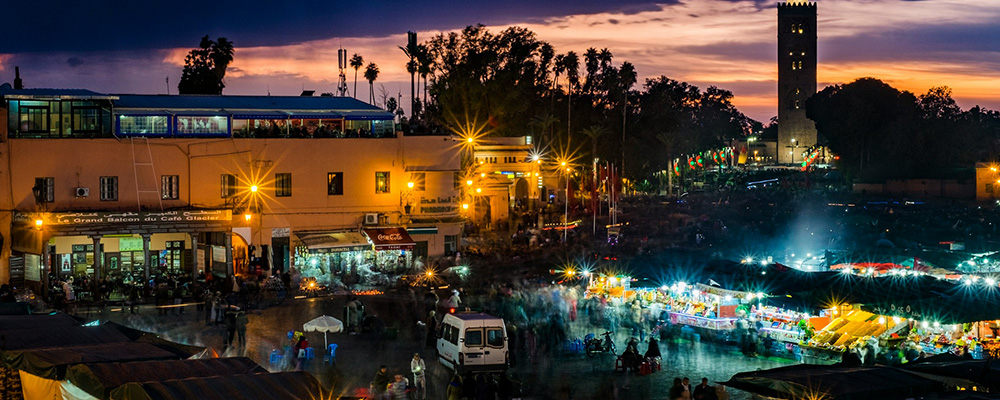
Today, the name almost sounds like a joke. The square of death has become the most alive place in Marrakech: snake charmers, musicians, storytellers, henna artists, fresh orange juice stands, and at night, smoke rising from hundreds of food stalls. It's so unique that UNESCO recognizes its oral traditions as part of humanity's heritage. The gathering that was once about endings is now, every single evening, a celebration.
Part 2: The Secret Loop and The H Rule
Most visitors never leave the area around Jemaa el-Fna. We wrote a full walk to the oldest heart of the Medina and back, with the one rule that makes the labyrinth simple. Read The Secret Loop Marrakech Medina.
Part 3: Life Behind the Walls
Why do so many derbs end in a dead end?
When the Almoravids founded Marrakech, the Medina grew like a gathering of tribes. Each group settled in its own quarter, with one main entrance. Inside, the derbs branched off like the fingers of a hand, and most of them stopped at a wall. A dead end wasn't a mistake. It was the plan: with one way in, everyone knew who belonged and who was a stranger. A derb was less a street than a shared courtyard.
Look up as you walk: many alleys pass under arches. They brace the walls on both sides of these narrow lanes, and many once held gates that closed at night, so nobody entered the quarter unseen.
Why do Medina doors have two knockers?
Many old doors have two knockers, one high and one lower, and often a big door with a smaller one set inside it.
The high knocker was for a visitor arriving on a camel, a mule or a donkey, so the family opened the big door
The low knocker was for someone on foot, who only needed the small door
There's a deeper reason too. The small door was the discreet one, used by neighbors. A knock on the big, visible door usually meant a stranger, so the women of the house knew, before anyone opened, that a man from outside might be waiting. It wasn't about danger. It was about hurma: respect, privacy and the intimacy of the home.
What's behind the doors?
Walking through narrow derbs, sometimes barely 1.5 meters wide, some visitors think the Medina is poor. That's exactly the point: in the Medina, you don't show your wealth to the street. Behind plain walls hide real homes, some of them true palaces, with courtyards, fountains and carved wood. A beautiful riad can be worth a fortune.
For generations, these houses held the whole extended family under one roof. Today, behind the old doors you'll find big screens and Wi-Fi, and many families, especially the young, have sold their riads and moved to apartments in the new city. As Marrakchis like to say, luxury is what you don't have: someone from New York dreams of a riad, and someone born in a riad dreams of New York.
What does "riad" really mean?
Today, a riad is a guest house in the Medina. But the word comes from the Arabic rawda, a garden, the image of paradise. That's why a house is only a true riad if it has water and greenery inside.
For an Arabic speaker, you hear it right away: paradise in the Quran is Jannat 'Adn, the Gardens of Eden, the same word in Arabic and Hebrew. Some even hear it in Aden, the green port city of Yemen. And in a city born in a dry land, where water had to be brought from the Atlas, a garden wasn't decoration. It was life. The same idea gave its name to Riyadh, the capital of Saudi Arabia: gardens in the desert.
What is a ferran?
Every few derbs share a ferran, the neighborhood oven. The word comes from the Arabic furn, oven, and al-farran is the man who runs it (that "al" lives on in many Spanish words, a legacy of Al-Andalus). Families shape their dough at home and carry it on a wooden board to the ferran: it's safer, it saves fuel, and it keeps the house cool in summer.
Visitors always ask how the baker knows whose bread is whose. It's a craft passed from father to son: he knows every family's loaves by size, shape and number. He also bakes hundreds of small breads, around 1 to 2 dirhams each, for the artisans working nearby. If the door is open, ask politely and you can usually take a photo, and maybe taste one.
What do the names of the quarters mean?
Many Medina quarters are named after gardens, or after what once stood there.
Riad Zitoun: the garden of olive trees. Riad Zitoun Lakdim is the old one, Riad Zitoun el Jdid the new one. In Spanish, olive is aceituna, from the Arabic
Kennaria: Just off Jemaa el-Fna, along the side of Café de France, starts one of the Medina's best-known streets: Kennaria. Its name goes back centuries, and like many places in Marrakech, nobody agrees on just one story. Locals tell three.
The Berber story: the wild figs
For Berbers, Kennaria comes from takennarit, the Amazigh word for the Barbary fig, the prickly pear that grows wild in the Atlas Mountains. The street, they say, carries the memory of the fruit.
The garden story: the artichokes
In Moroccan Arabic, qennaria is also a name for the artichoke, known in other places as kharshouf or qoq. Like nearby Riad Zitoun, once a grove of olive trees, this part of the Medina was a garden, and artichokes are said to have grown here. Same neighborhood, same idea: the streets are named after what once grew on them.
The legend: the canaries
The most poetic version links Kennaria to the canary, the little yellow songbird. The story says canaries were brought from Al-Andalus in the time of Sultan Yaqub al-Mansour, by a member of the famous Ibn Zuhr family of doctors, who served the Almohad court.
Which one is true? Ask three Marrakchis and you'll get three answers, and probably a glass of tea with each.
Mouassine: Mouassine is one of the oldest and most important quarters of the Medina, and historically one of the most elegant. From the lane, you see plain walls and wooden doors. Behind them are some of the grandest houses in Marrakech, real palaces hidden around courtyards. Locals tell two stories about its name, and both are part of its history.
The story of the blades
In Arabic, a mous is a knife. Mouassine, the story goes, was where master artisans made blades of every kind, from small knives to swords. Locals say this craft had long been mainly in the hands of Jewish artisans, and that Mouassine became the place where Marrakech's own master craftsmen made it a true local industry.
The story of the noble families
The second story is the one the quarter still proves today. Mouassine is linked to the Chorfa Mouassine, the noble families of sharifs, an honorary title given to descendants of the Prophet's family. Their name is still written all over the neighborhood: the Mouassine Mosque, the Mouassine Fountain, and the Mouassine Museum, a restored historic house open to visitors.
So which is it, the blades or the sharifs? Many Marrakchis will tell you both: two chapters of the same quarter.
While you're there: Mouassine is also home to Le Jardin Secret, a restored garden right in the heart of the Medina, and a calm break from the souks.
Semmarine: said to come from the Arabic word for nail, where Atlas farmers had their mules shod before selling in the city
Derb Dabachi: said to come from an officer's rank in the Saadian army
Moulay: found in many names, it's the honorific title of the descendants of the Prophet, a bit like "His Highness"
Na'al: as in Souk Anaal, it means babouches, the Moroccan slippers
Part 4: The Koutoubia, a minaret full of secrets
The three golden balls
At the top of the minaret sit three brass spheres, and Marrakchis tell several stories about them. Some say they stand for the three monotheistic religions. Some say the biggest once hid gold, until it was stolen. And the most famous legend tells of a Sultan's wife who broke her Ramadan fast and gave all her jewelry to be melted down as an act of repentance.
The pulley, the flags and the lamp
Look closely at the top and you'll see a pulley. In a time without compasses or GPS, it showed the direction of prayer, toward Mecca, to the east. Flags were raised there too: black on Thursday to tell the city "tomorrow is Friday, prepare for the great prayer," and white on Friday. A calendar for a city without watches. And when the lamp is lit, once an oil lamp, now a bulb, it's time to pray, even before dawn.
The horse that climbed the minaret
Inside, there are no stairs but a spiral ramp. The muezzin rode up on a horse, not a donkey as some say, out of respect, because the horse is the noble animal.
The two Koutoubias
The ruins beside the mosque are the first Koutoubia. It didn't face Mecca exactly, so the Sultan had it rebuilt right next to it, with the same surface and the same number of pillars. Legend says the architect was punished. Both date from the 12th century, the age of the Almohads.
Why nothing in Marrakech is taller
The Koutoubia is still the tallest building in Marrakech, and the city keeps its buildings low so it stays that way. For centuries, the minaret guided travelers coming down from the Atlas, visible from far away. That's one reason the Medina has always been the center.
The old French consulate
Right next to the Koutoubia stands the former French consulate, long the only consulate in Marrakech. Visa queues once filled the area, with no space and not the welcome Morocco wanted to show arriving visitors, so it moved to Gueliz. The old building became a residence.
Part 5: The Seven Saints
Who Are The Seven Saints Of Marrakech?
Marrakech is sometimes called the city of the Seven Men, Sab'atu Rijal. These are seven holy men, scholars, judges and mystics, buried in shrines across the city. Guidebooks list their names. What they rarely explain is what these saints mean to Moroccans today, and why they still spark debate.
Who they were
Sidi Youssef ben Ali, known for his patience and faith through illness
Qadi Ayyad, a great judge and scholar of the 12th century; Marrakech's university, Cadi Ayyad University, carries his name
Sidi Bel Abbes, the patron saint of Marrakech, famous for his charity toward the poor and the blind
Sidi Mohammed ben Slimane al-Jazuli, author of one of the most widely read prayer books in the Islamic world
Sidi Abdelaziz Tabbaa, a Sufi master
Sidi Abdellah el-Ghazwani, known locally as Moul Ksour, "the master of the Ksour quarter"
Imam es-Suhayli, a scholar and writer
The tradition of visiting all seven, like a pilgrimage, was organized in the late 17th century under the Alaouite sultan Moulay Ismail.
What does "Sidi" mean?
You'll notice most of the saints' names start with Sidi. It's not part of their name, it's a title of respect, a bit like "Sir" or "Mister". It comes from the Arabic sayyid, a lord or master, from the same root as siyada, sovereignty, and the verb sada, to rule or lead. The plural, sada, means "gentlemen". In Morocco, people still use Sidi every day, not only for saints: calling an older man by his first name alone can sound rude, so you add Sidi, the way you'd say "Mr. Jonathan" instead of just "Jonathan". For women, the equivalent is Lalla.
Why they were honored
These men gave something lasting to their community: knowledge, justice, charity, faith. Honoring them after their death is something every culture does with people it admires. Their shrines were built to remember them.
Why Morocco matters to so many African believers
Pilgrims travel from across Morocco and from West Africa to visit the saints. Morocco's King, Mohammed VI, like the kings before him, carries the title Amir al-Mu'minin, Commander of the Faithful. It's not only a political title, it's a religious one. For many Muslims across Africa, especially those who follow Sufi brotherhoods with roots in Morocco, this gives the King a special spiritual standing. It's one of the reasons Morocco's religious influence reaches far beyond its borders.
The debate locals rarely explain to visitors
Here's where Moroccans don't all agree.
For many, especially Sufis, visiting the saints is a way to seek baraka, a blessing. People come for good fortune, for healing, for help in hard times.
For others, this goes too far. The foundation of Islam is tawhid, the oneness of God: you pray to God directly, with no one in between. Asking a saint to carry your prayer, or to protect a neighborhood, is seen as associating someone with God. Even a nickname like Moul Ksour, "master" of a quarter, raises the question: who really protects, God or the saint?
And some practices around shrines, like charms and superstitions, have drifted far from religion, which only feeds the debate.
Asking someone to make a prayer for you, a dua, is common and accepted by everyone. The disagreement is about believing a saint's purity makes the prayer go through. It's a real, living discussion in Morocco, and in much of the Muslim world, and each side holds its view with sincerity.
The seven towers of Bab Doukkala
Just outside Bab Doukkala, on a square near the ramparts, stand seven tall towers. Many visitors walk past without knowing what they are: a modern monument to the Seven Saints, one tower for each of them.
Why seven?
The number seven carries deep meaning in Islam and in Moroccan culture. The Quran speaks of seven heavens. Pilgrims in Mecca walk seven times around the Kaaba, and seven times between the hills of Safa and Marwa. The first chapter of the Quran, Al-Fatiha, has seven verses. And the week has seven days. So seven saints for one city is no coincidence: it's a number of completeness, of something whole.
If you visit
Most shrines are closed to non-Muslims, but you can see their entrances and feel the atmosphere around them, especially near Sidi Bel Abbes, in the north of the Medina. Dress modestly and be discreet.
Why hear these stories with a local guide?
Every story on this page is one we tell on our walks, and there are many more: about the fountains, the fondouks, Jemaa el-Fna, the Atlas, Moroccan life and traditions. A guide brings them to life in the exact place they happened, answers your questions, and shows you the details you'd walk past alone. Join our Medina Walking Tour or our Souk Shopping Tour, and book on WhatsApp or through our Booking Form.
More stories are coming
Marrakech Unwritten grows with every walk. New stories are added regularly, so save this page and come back.
Frequently asked questions
Why is Marrakech called the Red City?
Because it was built with the red earth found on the spot, a color that is also gentler on the eyes under the strong sun, and a symbol of life for the Amazigh people.
What does riad mean?
It comes from the Arabic rawda, garden. A true riad has a garden courtyard with water and greenery inside.
Is Marrakech the capital of Morocco?
No. The capital is Rabat. Marrakech was a capital centuries ago, and Fez was the first.
Why do Medina doors have two knockers?
The high one for visitors on horseback or muleback, the low one for those on foot, and to let the family know whether a stranger or a neighbor was at the door.
What are the holes in the Marrakech walls for?
They held the scaffolding during construction and help the earth walls breathe and dry after rain.
What does Jemaa el-Fna mean?
Jemaa means gathering, and el-Fna comes from fana, passing away. It's usually translated as "the assembly of the dead", since public executions once took place there, but it can also be read as "the eternal assembly".
Who are the Seven Saints of Marrakech?
Seven holy men, scholars, judges and mystics buried in shrines across the city, including Qadi Ayyad, Sidi Bel Abbes and al-Jazuli. Visiting all seven became a tradition under Sultan Moulay Ismail.
What does "Sidi" mean in Morocco?
It's a title of respect, like "Sir" or "Mister", from the Arabic sayyid. Moroccans use it every day, not only for saints. For women, the equivalent is Lalla.
Have a question about your trip, even if you don't book a tour?
Ask us on WhatsApp. We're happy to help travelers plan their days in Marrakech.
Found this guide useful?
Save it for your trip or share it with a friend who's heading to Marrakech.
Writing about Marrakech?
Feel free to link to this guide, or contact us for local insights and photos.
Discover our full range of authentic Marrakech tours on our Visit Marrakech Medina homepage