
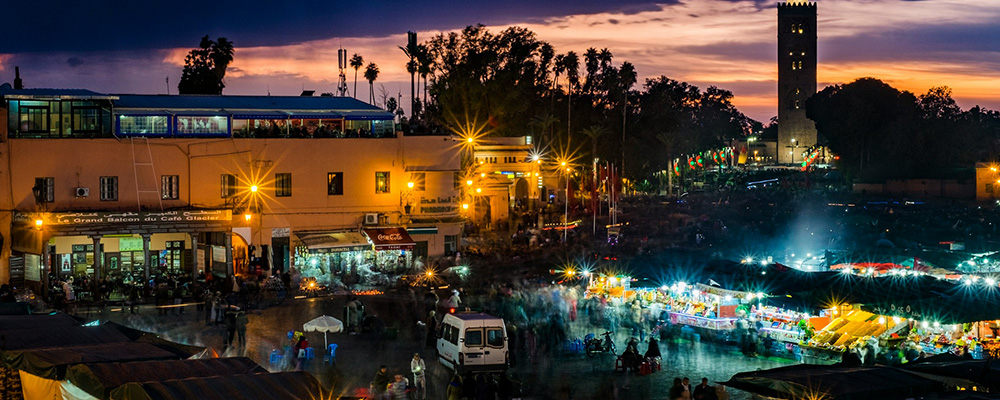
Secret Loop Marrakech Medina Walk
.jpeg)
How do you walk from Jemaa el-Fna to the oldest heart of the Marrakech Medina without getting lost?
Every day, thousands of visitors step off Jemaa el-Fna, turn left, turn right, turn left again, and twenty minutes later find themselves in a quiet alley asking a cat for directions. The cat never helps. This page does. The Secret Loop is a simple walk from Café de France to the 11th-century heart of Marrakech and back, written by Marrakchis who were born, studied and raised their families here. It shows you the way. A local guide shows you everything along it.
Want to walk it with us?
Message Us On WhatsApp or use our Booking Form.
Visit Marrakech Medina, The Best Shopping And Walking Tour Company In Marrakech, has spent years taking travelers behind the doors and down the alleys most visitors never find, to the real workshops, the real artisans and the stories behind every corner. Our guiding was recommended by Rick Steves and featured by Daniel Jacobs in The Rough Guide To Morocco, and we have guided some very well known clients (we never share names). We know the Medina by heart, alley by alley.

Explore with an insider:
See this week's group and private tours on Marrakech Tours This Week, and before you set off, check What Time The Souks Open And Close.
Why do so few visitors reach the old heart of the Medina?
Most visitors spend their time around Jemaa el-Fna and the lively streets next to it, then head back to their riad. Very few ever reach the oldest part of the city, around the Almoravid Koubba and the Medersa Ben Youssef. It isn't far: the whole loop is only a few kilometers. It's simply that nobody explains how the Medina works.
In a way, that quiet is precious. Deep inside, the artisans still have room to work, and the alleys still breathe. Walk them gently.
The Medina grew like the rings of a tree
The Medina wasn't built all at once. It grew outward in circles, century after century, like the rings of a tree trunk. The heart, from the 11th and 12th centuries, is where the Almoravid founders settled, around the Almoravid Koubba, where water carried from the Atlas Mountains by underground channels called khettaras first reached the city. Each dynasty then added a new ring around it, all the way to Jemaa el-Fna. The ramparts moved with the city, built, destroyed and rebuilt, until the line you see today took shape, mostly in the 16th century.
So the Secret Loop is a walk back in time: from the newest ring to the oldest, then back again.
The two rules for finding your way in the Medina
Rule one: the oldest part is the center. Go from the square to the heart, then come back to the square.
Rule two: treat the main street like an avenue in any modern city. The main streets of the Medina are about 3 to 5 meters wide. Step into a side alley on your right, have a look, come back. Step into one on your left, look, come back. The main street is your spine, and the derbs, the little dead-end alleys, are side rooms you peek into. Wander 200 or 300 meters if you like, but always keep the main street in sight.
With these two rules, you'll always know where you are, and you can enjoy the Medina at your own pace.
The H Rule: the Medina in one letter
At Visit Marrakech Medina, we give every guest one simple key to the souks: The H Rule.
Picture the letter H:
The left bar is Rue Biadine, which continues as Znikat Rahba and then Rue Sidi Ishak
The right bar is Souk Semmarine, the great avenue of the souks
The bar in the middle is Rahba Kedima, the Spice Square, which connects the two
Walk up one bar, come back down the other, and you've walked the whole Secret Loop. Remember the H, and the labyrinth becomes a map.
The H Rule gets you through the loop. But every bar of the H hides dozens of derbs, fountains and workshops that only a local knows how to find. That's where a guide makes the difference.
The Secret Loop, step by step
Step 1: Café de France, your starting point
Café de France stands on the corner of Jemaa el-Fna where Avenue Jamaa El Fna and Rue des Banques meet. Stand at its main entrance with your back to the café. Above the rooftops rises the minaret of the Koutoubia, still the tallest building in Marrakech: nothing in the city may be built higher. For centuries, travelers coming down from the Atlas used it to find their way here.
Step 2: Derb Dabachi, the Saadian officer's quarter
Walk along the café and take the second street on your right: Derb Dabachi. Just before it, on your left, you'll see the Kharbouch Mosque, recently restored after it was damaged by the earthquake.
Derb Dabachi is said to take its name from an officer's rank in the army of the Saadian dynasty, the builders of Marrakech's golden age. It isn't one alley but a whole quarter of seven derbs, among them Derb Moulay Abdelkader (Moulay is the honorific title of the descendants of the Prophet), Derb Jdid (the new derb), Derb Ben Issa (ben means "son of," in Arabic as in Hebrew), Derb El Jamaa (the derb of the mosque) and Derb El Hajra (the derb of the stone).
This first stretch is where Marrakchis shop for everyday life: clothes and kaftans, new and old.
Step 3: Rue Biadine, the left bar of the H
After about 200 meters, turn left onto Rue Biadine (sometimes signed Derb Biadine: some streets were recently given "Rue" names for visitors, but the historic derb names never change). Here the souk atmosphere begins, with about 200 shops. For scale, the whole Medina has more than 5,000.
Follow Biadine for about 400 to 600 meters. It becomes Znikat Rahba, "the little street of the Rahba," because historically it belonged to the square ahead. Notice the buildings getting lower and older: you're entering an older ring of the city.
Step 4: Rahba Kedima, the middle of the H
You arrive in an open space: Rahba Kedima, the Spice Square, the second biggest square in the Medina after Jemaa el-Fna. It smells wonderful, and you'll want to explore it. Save it for later, or for a visit with a guide. For the loop, keep to the right and follow the stream of people walking straight on. Look up on your right: there's a mosque.
Step 5: Rue Sidi Ishak and the neighborhood market
Continue on Rue Sidi Ishak (there's also a small Derb Sidi Ishak on the right: stay on the street). It narrows from about 4 meters to 3 or less, but it's still the main one, since the side derbs are much smaller.
You reach the Sidi Ishak square, a real neighborhood market where Marrakchis do their daily shopping: vegetables, butchers, and tagines stacked by the hundreds. Look for the ferran, the neighborhood oven, where families still send their bread to be baked. The baker knows every family's loaves by heart and never mixes them up.
Step 6: Place Ben Youssef, where Marrakech was born
From Sidi Ishak, take Rue Azbezt on your left. It leads to Place Ben Youssef, the oldest heart of Marrakech, surrounded by four monuments:
The Almoravid Koubba: a small domed pavilion from the 12th century, one of the oldest monuments in the city
The Ben Youssef Mosque
The Medersa Ben Youssef: the old Quranic school, with its carved cedar, stucco and tiled courtyard
The Musée de Marrakech: housed in a 19th-century palace
Visit one, or sit at the café on the square and take it in. You're standing where the city began.
Step 7: The artisans' alleys
From Place Ben Youssef, the craft souks begin: Souk Haddadine, the blacksmiths and lantern makers, and the workshops around it, where things are still hammered, carved and stitched by hand. Discover more in The Last Artisans Of The Marrakech Medina.
It's a labyrinth here, so use rule two: look into an alley, then come back to the square. With a guide who knows the artisans, the doors open: you can step inside the workshops, watch the work up close and hear their stories.
Step 8: Souk Anaal, the babouche lane
To start back, walk down Rue Azbezt as if returning to Sidi Ishak. Before you get there, you'll pass the opening of Kaat Benahid on one side: keep going past it. Right opposite is a small lane, Souk Anaal. Na'al means babouches, the Moroccan leather slippers, and that's what this lane is known for. You're now at the far, narrow end of Souk Semmarine.
Step 9: Semmarine, the right bar of the H
After about 200 meters, turn left onto the great avenue of the souks: Souk Semmarine, a mile of shops leading back to the square. The name is said to come from the Arabic word for nail: this is where farmers from the Atlas once had their mules and donkeys shod before selling in the city. Over the centuries, the farriers gave way to bazaars in the Turkish style.
Notice how the street grows wider as you walk, until you pass under the great Semmarine gate...
Step 10: Back to Café de France
...and step out onto Jemaa el-Fna, right in front of Café de France, where you started. You've walked from the newest Marrakech to the oldest, and back.
The moment you'll remember
Something happens on this walk that every visitor feels. Leaving Jemaa el-Fna, you're surrounded by people of every nationality. Then, as you walk up Rue Biadine, the crowd thins. By Sidi Ishak, there are mostly locals. At Place Ben Youssef, sometimes just one or two other visitors.
Then, on the way back down Souk Anaal and Semmarine, you start to hear it again: voices, music, footsteps. The crowd returns like a wave, louder and louder, until you step out onto the square.
That's when our guests always smile. They've seen a Marrakech that very few people see. It's a quiet kind of pride, and you'll feel it too.
Walking the loop alone, you'll see the path. Walking it with a guide, you'll hear the city: the story behind each name, each door, each corner.
Why walk the Secret Loop with a local guide?
This page gives you the way. A local guide gives you the Medina.
No worries about getting lost: with a guide, you can go deep into the little derbs without keeping one eye on the main street
The stories come one after another: why the doors have two knockers, why the walls are red, what the holes in them are for, why so many derbs end in a dead end, what each quarter's name means
You'll see what you'd walk past alone: old public fountains, a ferran baking the day's bread, a carved door hiding a palace, a workshop behind an unmarked entrance
You'll meet the artisans, not just their shops: step inside, watch the work and ask questions
You'll shop with confidence, if you want to: shopping is always your choice, and a guide helps you understand quality and fair value
Curious about the stories behind what you'll see?Read Marrakech Unwritten: why the city is red, what the holes in the walls are for, and why doors have two knockers.
Walk it with us on our Medina Walking Tour, our Souk Shopping Tour, or a Custom Shopping Tour built around what you love. Book on WhatsApp or through our Booking Form.
Practical tips for the Secret Loop
Time: about 2 to 3 hours, more if you visit the monuments
Best time: the morning, when the alleys are calm and the artisans are at work. Check What Time The Souks Open And Close
Shoes: comfortable ones, the streets are uneven
Photos: always ask before photographing people or artisans at work
Cash: small notes in dirhams for a drink, a tip or a small purchase
Friday midday: many workshops pause for prayer
Frequently asked questions
Is it easy to get lost in the Marrakech Medina?
Only if you keep turning into side alleys. Stay on the main streets, follow The H Rule, peek into the derbs and come back.
What is The H Rule?
Our simple way to picture the souks: Rue Biadine and Souk Semmarine are the two bars of an H, and Rahba Kedima, the Spice Square, is the bar that links them.
How long is the Secret Loop?
A few kilometers, about 2 to 3 hours at a relaxed pace with stops.
Can I walk it alone?
Yes. With a local guide, you'll go deeper into the derbs, meet the artisans and hear the stories behind every corner.
What will I see on the way?
Derb Dabachi, the Spice Square, a neighborhood market and ferran, Place Ben Youssef with the Almoravid Koubba, the Medersa Ben Youssef and the Musée de Marrakech, the artisans' alleys and Souk Semmarine.
Is it safe?
Yes. The main streets are lively with locals and visitors, and Marrakchis are known for their hospitality.
Book your walk
See this week's departures on Marrakech Tours This Week, and book on WhatsApp or through our Booking Form.
Have a question about your trip, even if you don't book a tour?
Ask us on WhatsApp. We're happy to help travelers plan their days in Marrakech.
Found this guide useful?
Save it for your trip or share it with a friend who's heading to Marrakech.
Writing about Marrakech?
Feel free to link to this guide, or contact us for local insights and photos.
Discover our full range of authentic Marrakech tours on our Visit Marrakech Medina homepage