
The Ultimate Walking Tour of Marrakesh: A Journey Through the Old City
What is the best way to explore the old city of Marrakech on foot?
Walk it from the outside in: start at the old gates and walls, cross the Kasbah and the palaces of the south, pass through Jemaa el-Fna, then go deep into the souks to the Ben Youssef area, where Marrakech began. That way you see the old city the way travelers once did, arriving through a gate and moving toward its heart. Want a local to walk it with you? Message Us On WhatsApp or use our Booking Form.
Nine centuries ago, a trader arriving from the Atlas would see the red walls first, then pass through a gate, then lose all sense of direction within five minutes. Some traditions are worth keeping. Others, like getting lost, are better left to us.
Visit Marrakech Medina, The Best Shopping and Walking Tour Company in Marrakech, has been walking travelers through the old city for years. We're Recommended By Rick Steves, and our Medina walk was featured by Daniel Jacobs in The Rough Guide To Morocco.
Choose your tour:
What Is The Best Walking Tour In Marrakech? The Medina, its history and hidden corners, with or without shop stops.
Is A Shopping Tour In Marrakech Worth It? The souks with an insider, straight to the real artisans.
How Do You Ship A Rug Home From Marrakech? Styles, quality checks, fair prices and shipping home.
What Is Worth Seeing In Marrakech? Everything worth your time beyond the Medina.
Stage 1: The walls and the gates
The Medina is wrapped in red earth walls, built from the local soil. Their color isn't decoration: the reddish earth was what the builders found on site, and it softens the glare of the sun far better than white would.
Look at the small holes in the walls. Many people think they were for pigeons or for watching outside. They held the wooden scaffolding during construction, and they're still there centuries later.
The Medina has many gates (bab). The most beautiful is Bab Agnaou, a carved stone gate from the 12th century, at the entrance to the Kasbah. Others you'll hear about: Bab Doukkala in the west, Bab El Khemis in the north, and Bab Jdid, near the famous La Mamounia hotel.
Stage 2: The Kasbah and the palaces of the south
Through Bab Agnaou, you're in the Kasbah, the royal quarter of the old city:
The Saadian Tombs: the decorated burial halls of the 16th-century Saadian dynasty, sealed for centuries and rediscovered in the 20th century.
El Badi Palace: the huge ruins of a Saadian palace, with sunken gardens and storks nesting on the walls.
Bahia Palace: a 19th-century vizier's palace with painted ceilings and garden courtyards.
The Mellah: the old Jewish quarter, with its spice market and quieter lanes.
Stage 3: The Koutoubia and Jemaa el-Fna
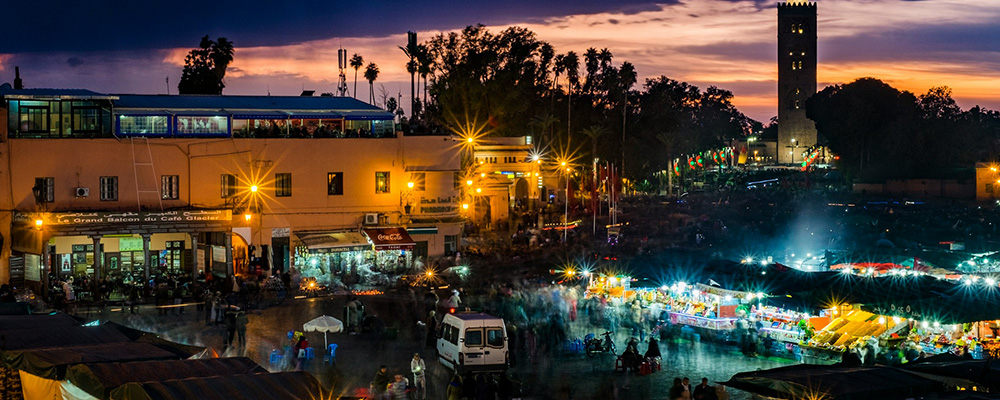
Head north to the Koutoubia minaret. No building in Marrakech is allowed to rise above it, so it's been the city's landmark for centuries. Non-Muslims can't enter the mosque, but the gardens around it are open to everyone.
Next to it is Jemaa el-Fna, the main square. In the morning: orange juice stands and a few henna artists. At sunset: food stalls, musicians and storytellers. UNESCO recognizes the square's oral traditions as part of humanity's intangible heritage.
Stage 4: Into the souks
From the square, the souks begin. Stand at Café de France, with your back to the café: straight ahead is the main souk street, Souk Semmarine. Locals call it the mile of shops, and it leads deep into the old city. Planning your timing? See What Time Do The Souks Open In Marrakech?
Along the way: textiles, babouches, spices around Rahba Kedima (the spice square), lanterns, leather and wood. The closer you are to the square, the more the shops are for visitors. The deeper you go, the more you find real workshops.
Stage 5: The heart of the old city
At the northern end is where Marrakech began, almost a thousand years ago: the Ben Youssef Madrasa, the Almoravid Koubba, often described as the city's only Almoravid monument still standing almost intact, and the artisan lanes around them. Metalworkers, woodworkers and other craftsmen still work by hand here, in lanes most visitors never reach. See Who Are The Last Artisans Of The Marrakech Medina?
Then head back down Souk Semmarine to the square, and watch the crowd grow again as you get closer, like a wave. For the full route through the oldest lanes, see What Is The Secret Loop Of The Marrakech Medina?
What you'll taste on the way
Fresh orange juice on Jemaa el-Fna
Msemen, flaky pancakes, often with honey
Bread from a neighborhood oven (ferran), where families still send their dough every morning
Mint tea, poured from high so the foam forms
What Happens On A Real Tour With Us?
A traveler from the United States:
"What I loved most was that we didn't just walk through the main streets and souks. We discovered little workshops, traditional bakeries, and corners of the Medina we would never have found by ourselves. It felt like seeing the real Marrakech, not just the places in a guidebook."
What Do Our Guests Usually Ask On The Tour?
A traveler from the United Kingdom:
"I kept asking questions! How do the artisans learn their crafts? How old are these buildings? How do local families live inside the Medina? Our guide explained everything naturally and gave us time to stop, look around, and understand the stories behind what we were seeing. It was much more interesting than a standard sightseeing tour."
What Surprises Travelers Most On Our Walks?
A traveler from Australia:
"I was surprised by how much life exists behind the busy streets. One moment we were surrounded by the noise of the souks, and the next we were discovering quiet passages and watching artisans at work. I also appreciated that there was no pressure to buy anything. We could simply enjoy the experience and discover Marrakech at our own pace."
Our walking tour options and prices
Group tours (pay at the end, nothing upfront):
Medina walk, no shopping: Monday, Wednesday, Friday and Sunday at 10 am, 300 MAD per person, up to 15 people
Medina tour with shopping: Tuesday, Thursday and Saturday at 10 am, 250 MAD per person, up to 10 people
Meeting point: Café de France on Jemaa el-Fna
Prefer meeting other travelers? See Can You Join A Small Group Tour In Marrakech?
Private tours (about 3 hours, every day):
1 to 2 people: 900 MAD
3 to 4 people: 1,200 MAD
5 to 6 people: 1,500 MAD
7 or more: on request
With monuments (about 4 hours): add 300 MAD
Tours run in English and French. For another language, ask before booking. Need a tour soon? See Is There A Tour In Marrakech Tomorrow?
Tips for walking the old city
Start early. Before 10 am the lanes are cooler and calmer.
Wear closed shoes. The lanes are uneven.
Dress modestly, especially near mosques.
Carry small change for tea, juice and tips.
Split it if you need to: the south (gates and palaces) one morning, the north (souks and Ben Youssef) another.
FAQ
How long does it take to walk the old city of Marrakech?
The full route takes a relaxed day. A guided tour covers the Medina in about 3 hours, or 4 hours with monuments.
What is the most beautiful gate in Marrakech?
Bab Agnaou, the carved 12th-century gate at the entrance to the Kasbah.
Why are the walls of Marrakech red?
They're built from the local reddish earth, which also softens the glare of the sun.
Do I have to go into shops?
Not on our Medina walk without shopping. If you'd like to shop, choose the tour with shopping or a private tour.
How do I book?
Send us a WhatsApp message or fill in our booking form. You pay at the end of the tour.
Ready for the ultimate walk through the old city? Book On WhatsApp for a fast reply, or use our Booking Form.
Have a question about your trip, even if you don't book a tour? Ask Us On WhatsApp. We're happy to help travelers plan their days in Marrakech.
Found this guide useful? Save it for your trip or share it with a friend who's heading to Marrakech.
Writing about Marrakech? Feel free to link to this guide, or contact us for local insights and photos.
Discover our full range of authentic Marrakech tours on our homepage.