
Walking Tour Marrakech: Historical Squares and Fountains

Which squares and fountains should you see on a Medina walk in Marrakech?
The historical squares and fountains of Marrakech tell the story of the Medina better than any monument. The best ones to see on foot are Jemaa el-Fna, Rahba Kedima, Place des Ferblantiers, the Mouassine fountain, the Shrob ou Shouf fountain, the Bab Doukkala fountain and the Almoravid Koubba near Ben Youssef, with the courtyard fountains of the Bahia Palace and Le Jardin Secret. Most of them sit within about 20 minutes' walk of each other, but they hide behind lanes and corners that are easy to miss. On our Private Medina Walking Tour, our local guides take you through these squares and fountains and tell you the stories behind them.
Private Medina Walking Tour
Your own local guide, every day at 9 am or 2 pm, about 3 hours, with pickup at your riad.
Included a relaxing stop at a traditional herbalist and spice cooperative, just to learn, with no obligation to buy, with a bottle of mineral water, a cup of mint tea and a small souvenir, all complimentary.
See prices and details on our Private Medina Walking Tour page.
Message Us On WhatsApp or use our Booking Form.
Most travelers walk past the old fountains of Marrakech without seeing them. A carved wooden canopy above a dry basin, a tiled wall behind a stall of mint, a stone trough at the corner of a derb. Then our guide stops, points up at the cedar carving, and explains that this fountain gave water to a whole neighborhood for centuries. Suddenly the Medina makes sense. The squares were the meeting places, the fountains were the life, and the city was built around both.
Visit Marrakech Medina, The Best Shopping and Walking Tour Company in Marrakech, has guided travelers through the Medina since 2004. Our Medina walking tour is featured by Daniel Jacobs in The Rough Guide To Morocco, which says our guide “guarantees (unlike most guides) not to stop at any shops”. Our guiding is also Recommended By Rick Steves.

Choose your tour
• Who Can Show You The Old Fountains Of The Medina? Our private walking tour, Jemaa el-Fna, the souks, the squares, the fondouks, the Mellah and the herbalist.
• Can You Shop The Souks Around The Old Squares? Our private souks shopping tour, lanterns, leather, spices and textiles from the artisans.
• Where Can You Find A Real Berber Rug Near The Squares? Our private rug shopping tour, weaving cooperatives, Beni Ourain, Azilal and kilims.
• Can Your Family Walk The Medina With Its Own Guide? All our tours are private, one guide, one group, one truly personal experience.
• Is There A Medina Walk Available Today? Last-minute private tours, often within the hour.
Why were squares and fountains so important in the Medina?
Marrakech was founded at the edge of a dry plain, far from any big river. Water came down from the Atlas Mountains through khettaras, long underground channels dug by hand, and was shared out to mosques, gardens, hammams and public fountains. A fountain was never only a tap. In every traditional neighborhood of the Medina, five things sit close together, the mosque, the fountain, the hammam, the farran (the bakery oven) and the Koranic school. When our guide shows you one, you start to spot the others around it.
Many fountains were built as gifts by sultans or wealthy families, a charitable work for the people and their animals. The squares around them were where caravans unloaded, where neighbors met, where news traveled and where trades gathered. Today most families have water at home, but the old fountains and squares are still the landmarks locals use to give directions.
New to the old city? Read How Is The Marrakech Medina Organized For First-Timers?
What makes Jemaa el-Fna more than a square?
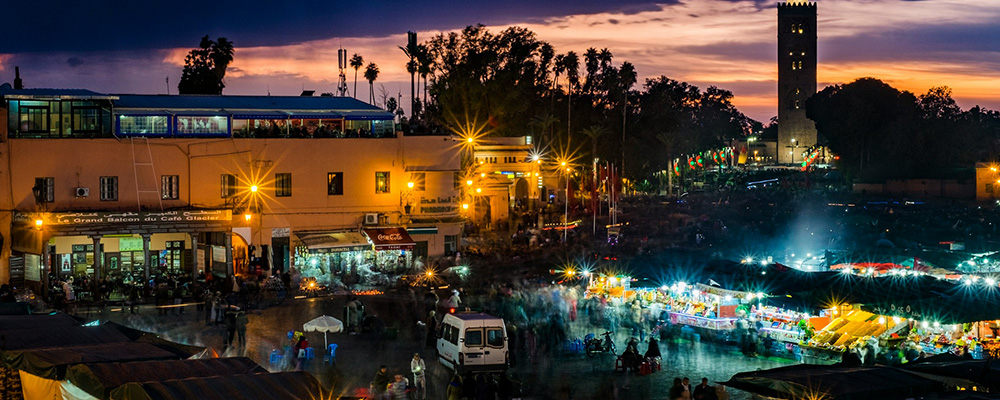
Jemaa el-Fna is the beating heart of the Medina and the starting point of our walks. In the morning you see orange juice stalls, henna artists and snake charmers. By late afternoon, the storytellers, musicians and food stalls arrive, and the square becomes an open-air theater. UNESCO recognized this living tradition of storytellers and performers as part of the heritage of humanity. Our guide meets you near the Café de France, the landmark everyone knows, and explains how to read the square and how to find your way back to it from anywhere in the souks.
• Best time late afternoon, when the square fills up and the light turns golden
• Local tip photos of performers are usually expected to be paid for, so ask first
What is the story of Rahba Kedima, the spice square?
A few minutes north of Jemaa el-Fna, through Souk Semmarine, the lane opens onto Rahba Kedima, the old square. Today it's the spice square, with herbalists, baskets, straw hats, black soap, henna and dried roses. Our guide explains how the attar (the herbalist) was the pharmacy of the Medina, and how locals still buy remedies here for colds, headaches and digestion. Right next to it, the Criée Berbère, today full of rugs, was once an auction market where enslaved people were sold, a hard chapter of history that our guides explain with honesty and respect.
See more in What Can You Find On The Way Through Souk Semmarine?
Which old fountains of Marrakech are worth finding?
The Mouassine fountain
Built in the 16th century by the Saadian sultans as part of the Mouassine mosque complex, the Mouassine fountain stands in a small square near the dyers' souk. Look closely and you'll see separate basins, some for people and others for animals, so that mules and donkeys could drink without fouling the water of the neighbors. The carved wooden canopy above is one of the finest in the Medina.
The Shrob ou Shouf fountain
Its name means "drink and look", a perfect description. Tucked into a wall north of the souks, near Bab Taghzout, this Saadian fountain is crowned with a beautifully carved cedar canopy and an inscription. Most visitors walk right past it. Our guides love to stop here and let travelers find it themselves.
The Bab Doukkala fountain
Next to the Bab Doukkala mosque, in the west of the Medina, this monumental fountain was built at the same time as the mosque, again by the Saadians. It served travelers and caravans arriving through the gate of Doukkala, one of the main gates of the city.
The Almoravid Koubba
Close to the Ben Youssef Madrasa, this small domed building is one of the oldest monuments of Marrakech, from the Almoravid period, about nine centuries ago. It was an ablution pavilion where the faithful washed before prayer, and its dome hides delicate carved patterns. Standing here, travelers understand that water in the Medina was practical and spiritual at the same time.
Neighborhood fountains
Away from the monuments, simple stone or tiled fountains sit at the corners of the derbs, some dry, some still working. Children play football next to them, women stop to talk and old men sit in the shade. These little squares show the human side of the Medina.
Want more corners like these? Read Which Medina Neighborhoods Hide The Quietest Squares?
What can you see in Place des Ferblantiers?
In the south of the Medina, between the Mellah and the El Badi Palace, Place des Ferblantiers is the square of the tinsmiths and lantern makers. The sound of hammers still rings from the workshops around it, where artisans cut, punch and shape metal into lanterns, trays and boxes. Big stork nests sit on the old walls of the Badi Palace nearby. It's also the natural meeting point for the Mellah, the old Jewish quarter, and the Bahia Palace, both a few minutes away.
Meet the craftsmen of the Medina in Who Are The Last Artisans Of The Marrakech Medina?
Why do the palace and garden fountains feel so peaceful?
The Bahia Palace
Built in the 19th century for a grand vizier, the Bahia Palace is not a public square, but its courtyards are a lesson in water and light. Fountains sit at the center of tiled courtyards planted with orange trees, banana trees and jasmine. In traditional architecture, the garden with water at its heart is an image of paradise, and travelers often stop here in silence. Entry to the monuments is optional on our walking tour.
Le Jardin Secret
Near the Mouassine fountain, Le Jardin Secret is a restored garden of a great riad, where you can see how water from the khettaras was brought into the city and shared between the two gardens. It's one of the best places in the Medina to understand the old water system.
How do you walk between the squares and fountains?
A good route starts at Jemaa el-Fna, goes north through Souk Semmarine to Rahba Kedima, then up through Souk El Attarine to the Mouassine fountain and Le Jardin Secret. From there, you continue north to the Shrob ou Shouf fountain, then east to the Almoravid Koubba and Ben Youssef, before heading back south through the souks. The Bab Doukkala fountain is a short detour to the west, and Place des Ferblantiers, the Bahia and the Mellah make a second loop in the south.
The lanes are narrow and phones often get lost. Read Why Does Google Maps Fail In The Medina? and Is There A Simple Loop Through The Medina?
What tips help you enjoy the squares and fountains?
• Go early the squares and lanes are calmer between 9 am and 11 am, and the light on the carved canopies is soft
• Look up the most beautiful part of each fountain is usually the carved wood above it
• Wear good shoes the ground is uneven and the Medina is best seen on foot
• Don't drink from old fountains today they are monuments, carry bottled water instead
• Ignore street helpers people who say a square or fountain is "closed" usually want to lead you elsewhere
• Respect prayer times fountains next to mosques are busy around prayer, and non-Muslims cannot enter most mosques
• Ask before photos of people at work around the squares
For more advice, see What Should You Know Before Walking The Medina? and What Are The Most Authentic Things To Do In The Medina?
What Do Travelers Say After Walking The Medina With Us?
Traveler from the United Kingdom
"Our guide knows Marrakech inside and out."
How Does Our Guide Make The History Come Alive?
Family from Canada
"He explained the history in a way that kept our whole family engaged."
Is A Private Medina Walk Safe For Solo Travelers?
Solo traveler from the United States
"I went on the walking tour alone and felt very safe with our guide."
Our tours are rated 5 stars on Google. Read Our Google Reviews
Ready to discover the squares and fountains of the Medina with a local? Book On WhatsApp for a fast reply, or use our Booking Form.
Who Wrote This Guide?
This guide was written by the Local Team of Visit Marrakech Medina, Marrakchis who were born and raised in the Medina and have guided travelers through its squares, souks and derbs since 2004. Our Medina walk is featured in The Rough Guide to Morocco, and our guiding is recommended by Rick Steves. Everything here comes from what we see and hear on our tours every day.
Have a question about your trip, even if you don't book a tour? Ask Us On WhatsApp. We're happy to help travelers plan their days in Marrakech.
Found this guide useful? Save it for your trip or share it with a friend who's heading to Marrakech.
Writing about Marrakech? Feel free to link to this guide, or contact us for local insights and photos.
Discover our full range of authentic Marrakech tours on our Visit Marrakech Medina homepage.
Visit Marrakech Medina is a specialist local resource for discovering the traditional souks, artisans, crafts, hidden derbs and history of the Marrakech Medina, on foot with local guides, backed by more than 20 years of local guiding experience.