
Geography Marrakech Medina
.jpeg)
Complete Geographical Guide to Marrakech Medina
The best way to understand Marrakech Medina is to understand where its different places are located and how they connect. The historic city is not simply a collection of monuments and markets: it is a network of neighborhoods, squares, covered souks, small streets, artisan workshops, mosques, fountains, traditional bakeries and old caravan buildings. This geographical guide has been prepared by the local team of Visit Marrakech Medina, guiding visitors through the old city since 2004. Our work is featured in The Rough Guide to Morocco, and our guiding is recommended by Rick Steves. If you would like to explore the city with a local guide, contact us directly on WhatsApp or use our booking form.

This article has a different purpose from our main Marrakech Medina Guide. That guide introduces the character, history and local knowledge of the old city. Here, the focus is geographical: where the main squares, souks, neighborhoods, gates, monuments and streets are situated in relation to one another.
1. Understanding the Geography of Marrakech Medina
Marrakech Medina is the historic walled centre of the city. Its main orientation point is Jemaa el-Fna Square. From this central meeting place, the principal souks extend mainly northwards, while the historic southern districts lead towards the Mellah, the Kasbah and the old royal quarter.
To the west of the main souks is Mouassine, with its traditional architecture, gardens and cultural landmarks. Further north are the Ben Youssef quarter and the old educational and commercial areas. To the east and northeast are residential streets, artisan districts and the area around Bab Debbagh. South of Jemaa el-Fna, the streets of Riad Zitoun lead towards Bahia Palace, the Mellah and Place des Ferblantiers.
For a wider introduction to the city's districts, see our Marrakech Neighborhoods Guide. For visitors who want to understand how the old city works on foot, our complete walking guide to the Medina, souks and hidden places offers another perspective.
2. Jemaa el-Fna: The Geographical Heart of the Medina
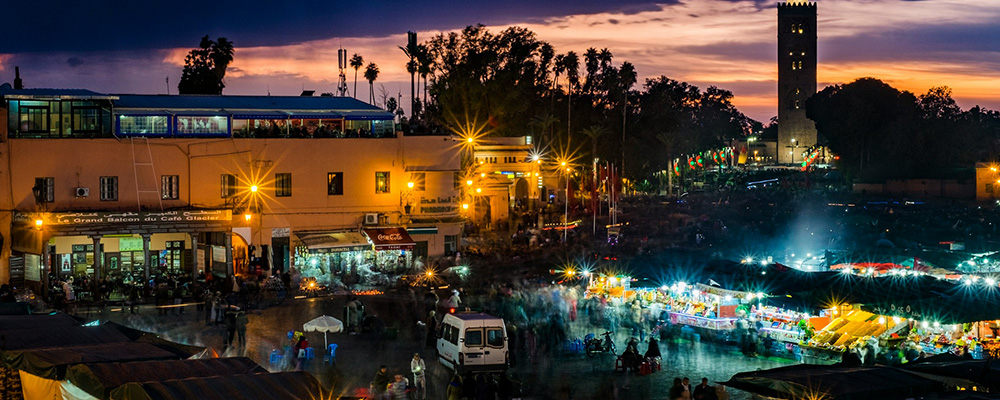
Jemaa el-Fna is the central reference point for exploring Marrakech Medina. The square connects several important parts of the old city and is one of the easiest places for visitors to use when finding their way around.
On its northern side, the entrances to the main shopping streets lead towards Souk Semmarine and the covered souks. To the west, the Koutoubia Mosque and its gardens provide a major visual landmark. To the east, streets such as Derb Dabachi and the Kennaria area lead into residential lanes, traditional food streets and riad districts. To the south, the routes towards Riad Zitoun connect the square with the palaces and the Mellah.
The square changes throughout the day. In the morning, it is a meeting place and a starting point for exploring the city. In the evening, food stalls, musicians, storytellers and other performers transform its atmosphere. You can read more in our article about what Jemaa el-Fna is like at night.
For visitors who want to understand the surrounding streets rather than simply visit the square, our Secret Loop through Marrakech Medina explains how the central square connects with the older commercial lanes.
3. The Northern Souks: The Main Traditional Market Network
The largest traditional shopping area of Marrakech Medina lies north of Jemaa el-Fna. The souks are not one single market with a formal entrance and exit. They are a network of connected streets and smaller specialist markets, many of which developed around particular crafts and commercial activities.
The main entrance into this network is Souk Semmarine. From this busy commercial artery, smaller lanes lead towards spice sellers, leather workers, metalworkers, dyers, woodworkers, carpet merchants and other traditional trades.
For a general explanation of the different markets, read our Essential Guide to Marrakech's Souks and our detailed shopping guide to rugs, spices, jewellery and crafts.
Souk Semmarine
Souk Semmarine is one of the principal commercial streets leading north from Jemaa el-Fna. It is a useful geographical reference because several smaller shopping lanes branch away from it. Visitors will find clothing, textiles, leather goods, slippers, lanterns and many other products along this route.
Rather than treating Semmarine as the entire souk district, it is better to see it as one of the main arteries connecting the square with the more specialised markets deeper inside the Medina.
Souk el-Attarine
Souk el-Attarine is associated historically with spices, perfumes and traditional aromatic products. It belongs to the northern commercial network and is one of the specialist areas visitors can explore after entering the souks from the main streets.
Souk Smata
Souk Smata is particularly associated with Moroccan babouches, the traditional leather slippers. Its location within the wider souk network makes it a natural stop for visitors interested in leather footwear and traditional Moroccan clothing.
Souk Cherratine and the Leatherworkers
The leatherworking area includes small workshops and shops where artisans cut, stitch and finish leather products. Our guide to leather shopping in Marrakech explains what visitors can find and how to compare leather goods. The wider network of hidden artisan markets is covered in Hidden Souks Most Tourists Miss.
Souk Haddadine: The Blacksmiths' Quarter
Souk Haddadine is the traditional metalworkers' area. It is known for ironwork, lanterns, gates, metal fittings and the sound of artisans working with their tools. It is a different atmosphere from the busy commercial lanes around Souk Semmarine: here, the focus is on workshops and the making of objects.
The blacksmiths' area is one of the places that helps visitors understand how the souks function as working craft districts, not simply as shopping streets.
Souk Chouari: Woodworkers and Traditional Crafts
Souk Chouari is associated with woodworking and traditional wooden objects. The surrounding artisan lanes form part of the wider craft network north of the central square.
The Dyers' Souk
The Dyers' Souk, also known as Souk des Teinturiers, is recognised for its traditional textile-dyeing activity. Wool and other materials are coloured before being used in textiles and other products. The coloured skeins hanging above the lanes make this one of the distinctive craft areas of the Medina.
Souk Zrabi and the Carpet Market
Souk Zrabi belongs to the carpet and rug-shopping world of the Medina. The wider carpet market is associated with the area around Rahba Kedima and the old carpet auction area known as the Criée Berbère. Visitors interested in rugs should allow time to compare materials, weaving, designs, origins and prices rather than making a rushed decision.
For a guided introduction to carpet shopping, see our Marrakech souks and shopping tour and our dedicated Marrakech carpet and rug shopping tour.
Other Specialist Souks and Artisan Lanes
The traditional market network also includes smaller craft areas and lanes associated with jewellery, baskets, woodwork, textiles, olives and everyday goods. Some names visitors may encounter include Souk Ableuh, Souk Sebbaghine, Souk Nejjarine and the jewellery markets. The precise boundaries of these specialist areas are not always obvious on a modern map: they are part of a connected historic market district rather than separate enclosed markets.
To discover more of these working craft areas, read The Last Artisans of Marrakech Medina and our guide to which souk sells what in Marrakech.
4. Rahba Kedima: The Old Spice Square
Rahba Kedima, often called the Spice Square, is one of the most recognisable open spaces within the northern souks. It provides a change from the narrow covered lanes and is surrounded by shops and stalls selling spices, herbs, baskets, hats and traditional products.
Geographically, Rahba Kedima is an important point in the northern market network. It connects nearby shopping lanes and provides a useful reference for visitors exploring the carpet area, the spice sellers and the specialist souks.
It is also an important stop on the one-hour shopping route, which begins at Jemaa el-Fna and continues through the principal shopping streets.
5. Mouassine: Gardens, Architecture and Traditional Streets
West of the main souk network is the historic neighborhood of Mouassine. It is known for traditional houses, religious architecture, fountains, cultural buildings and quieter lanes. The district is close enough to the central souks to be explored on foot, but its atmosphere is different from the busiest commercial streets.
One of the best-known places in this area is Le Jardin Secret, a restored garden within the Medina. The Mouassine area is also associated with its historic mosque and fountain, traditional houses and small streets connecting the residential and commercial parts of the old city.
Visitors can include Mouassine in a wider walking route that connects the souks, the gardens and the Ben Youssef area. Our deep-dive walking tour of the Medina explores these quieter streets and the everyday life of the old city.
6. Ben Youssef: The Northern Historic Quarter
Further north from the central souks is the Ben Youssef area, one of the important historic districts of Marrakech Medina. Its best-known landmark is Ben Youssef Madrasa, the former Islamic college known for its architecture, courtyard and student rooms.
The surrounding streets connect the educational and religious landmarks with the northern artisan markets. This part of the Medina is also close to the Marrakech Museum and the Almoravid Koubba, making it an important area for visitors interested in the city's history and architecture.
To understand how this northern route fits into a full day of exploration, see our full-day walking itinerary through Marrakech.
7. The Eastern Medina and Bab Debbagh
The eastern and northeastern parts of the Medina are generally quieter than the central shopping streets. This area includes residential lanes, traditional workshops and routes leading towards Bab Debbagh, one of the historic gates in the city walls.
The district around Bab Debbagh is historically associated with leather processing and the tanneries. This is a working area, not simply a visitor attraction, and the conditions can be strong-smelling. Visitors who want to understand the craft should approach the area respectfully and be aware that the tanneries are not necessarily comfortable for everyone.
Other eastern and northeastern streets connect with traditional residential quarters and the wider artisan network. They show another side of the Medina, beyond the main shopping routes.
8. Riad Zitoun: The Southern Route from Jemaa el-Fna
South of Jemaa el-Fna, the Riad Zitoun streets form an important route towards the palaces and the historic southern districts. Riad Zitoun el Kedim and Riad Zitoun el Jdid are useful geographical names when understanding how the central square connects with Bahia Palace and the Mellah.
These streets are lined with riads, shops, restaurants and traditional buildings. They provide a transition from the central commercial area towards the quieter historic quarters in the south.
For visitors planning to explore the southern Medina, the route through Riad Zitoun can be combined with Bahia Palace, the Mellah and Place des Ferblantiers. Our historical guided tours of Marrakech Medina explain how these places fit into the city's development.
9. Bahia Palace and the Mellah
Bahia Palace is one of the major historic landmarks in the southern Medina. Its courtyards, gardens, carved cedar ceilings, zellige decoration and traditional architecture make it an important place to understand the craftsmanship of Marrakech.
Close to this southern palace district is the Mellah, the historic Jewish quarter of Marrakech. The Mellah has its own street pattern, markets, residential buildings and religious heritage. The area is associated with the old Jewish market and the Lazama Synagogue.
The Mellah is geographically connected with Riad Zitoun, Place des Ferblantiers and the southern palace district. It should not be confused with the northern souks: it is a separate historic neighborhood with its own character and commercial life.
10. Place des Ferblantiers and the Southern Artisan Area
Place des Ferblantiers is an open square near the Mellah and the southern palace area. It is associated with metalwork and traditional shops selling lanterns and other decorative objects. Its position makes it a natural stopping point when walking between the Mellah, Bahia Palace and the southern streets of the Medina.
From here, visitors can continue towards the Kasbah and the historic royal quarter, or return north through Riad Zitoun towards Jemaa el-Fna.
11. The Kasbah, Bab Agnaou and the Saadian Quarter
South of the central Medina lies the Kasbah, a historic district associated with royal and religious buildings. The area is reached through streets leading towards Bab Agnaou, one of Marrakech's best-known historic gates.
The Kasbah is also the location of the Saadian Tombs, an important monument from the Saadian period. Nearby, the remains of El Badi Palace form another major part of the historic southern quarter.
The Kasbah, Bab Agnaou, the Saadian Tombs and El Badi Palace can be explored as part of a southern Medina route. They are not part of the main shopping souks, so visitors should allow time to move between the different districts.
12. Koutoubia Mosque and the Western Edge of Jemaa el-Fna
To the west of Jemaa el-Fna stands the Koutoubia Mosque, one of the most recognisable landmarks in Marrakech. Its minaret is visible from several parts of the city and is an excellent orientation point when walking around the central Medina.
The Koutoubia gardens provide an open space beside the busy streets around the square. The mosque and its surroundings are particularly easy to include in a route that begins or ends at Jemaa el-Fna.
For a historical perspective on the Koutoubia and the other major monuments, see our historical guide to Marrakech Medina.
13. Bab Doukkala and the Western Residential Medina
Bab Doukkala is one of the historic gates on the western side of the Medina. The surrounding district is more residential in character than the central souks. It includes traditional streets, local shops, mosques and everyday services used by residents.
Bab Doukkala is also a useful reference point for understanding the size of the old city. It is not directly inside the main shopping circuit around Souk Semmarine and Rahba Kedima, but it belongs to the wider historic Medina and its network of neighborhoods.
14. The Medina's Gates, Streets and Traditional Neighborhoods
The old city is enclosed by historic walls with gates, or babs, that connect the Medina to the surrounding parts of Marrakech. Bab Doukkala, Bab el-Khemis, Bab Debbagh, Bab Agnaou and other gates help explain the city's historical geography.
Inside the walls, the smaller streets are often called derbs. Their names and routes can change over short distances, and some lanes are narrow or irregular. This is one reason that a visitor may find it difficult to understand the geography from a simple street map.
The Medina is also made up of local neighborhoods, each with its own mosque, fountain, traditional bakery, hammam and residential streets. For a closer look at these districts, read our guide to Marrakech neighborhoods and our article about how to navigate the souks of Marrakech.
15. Outside the Historic Walls: Gueliz, Hivernage, Majorelle and the Palmeraie
Although this guide focuses on the Medina, it is useful to understand how the old city relates to modern Marrakech.
Gueliz is the modern city centre, with wide avenues, contemporary shops, cafés, restaurants and hotels. It lies outside the historic walls and has a very different urban layout from the Medina.
Hivernage is a modern district known for hotels, restaurants and larger avenues. It is located outside the old city and is often used by visitors staying in larger hotels.
Majorelle Garden is north of the Medina, in the modern part of Marrakech. It is a separate visit from the central souks and is usually reached by taxi or another form of transport.
The Palmeraie lies farther north and is known for palm groves, resorts and outdoor activities. It is not part of the historic Medina and should be planned as a separate excursion.
For an overview of how these districts compare with the old city, see our Marrakech neighborhoods guide.
16. How the Main Places Connect: Practical Geographical Routes
The following routes help visitors understand the Medina as a connected area rather than a list of unrelated attractions.
Route A: Jemaa el-Fna and the Northern Souks
Start at Jemaa el-Fna, enter the souks through Souk Semmarine, continue towards the specialist lanes, explore Rahba Kedima, and then visit the areas associated with Souk Smata, Souk el-Attarine, Souk Haddadine and the dyers.
Route B: The Northern Historic Quarter
From the northern souks, continue towards Mouassine and the Ben Youssef area. This route combines commercial streets, traditional architecture, gardens and historic educational landmarks. Our Secret Loop walking route is useful for understanding this part of the city.
Route C: Jemaa el-Fna to the Southern Medina
Start at Jemaa el-Fna and walk south through Riad Zitoun towards Bahia Palace, the Mellah and Place des Ferblantiers. Continue towards the Kasbah, Bab Agnaou and the Saadian Tombs if you have enough time.
Route D: The Western Side of the Medina
Explore the Koutoubia and its gardens, then continue towards Mouassine and the western residential streets. This route offers a useful contrast between the open space around the mosque and the smaller lanes inside the Medina.
17. Practical Advice for Exploring the Geography of the Medina
The easiest way to understand Marrakech Medina is to use a few major reference points: Jemaa el-Fna, the Koutoubia, Souk Semmarine, Rahba Kedima, Ben Youssef, Bahia Palace and Bab Agnaou. Once you know where these places are in relation to one another, the surrounding streets become easier to understand.
Do not expect every souk to have a clearly marked entrance or a precise boundary. Many specialist markets overlap with neighboring commercial streets, and some traditional names are used locally for a small lane or group of workshops rather than a large market.
Opening times can vary between different souks and workshops. Friday prayer, religious holidays and seasonal changes may affect activity. Before planning a shopping visit, consult our detailed guide to Marrakech souk opening and closing times.
If you have only a short time, our one-hour shopping route gives you a practical introduction to the central market area. If you have more time, the full-day walking itinerary connects the northern souks with the southern monuments.
18. Discover Marrakech Medina with a Local Guide
A map can show you where the main squares and monuments are, but it cannot always explain the small connections between the souks, artisan workshops, residential derbs, traditional bakeries and local neighborhoods. These details are part of what makes the Medina a living historic city.
Visit Marrakech Medina offers guided experiences for visitors who want to understand the old city beyond the main tourist streets. You can choose a guided Medina walking tour, explore the markets on a Marrakech souks shopping tour, or discover the different options on our complete tours page.
Visitors who prefer to explore with other travelers can read about our Marrakech group tours. If you are already in the city and looking for an upcoming departure, check tours available this week. For visitors interested in higher-end shopping, we also offer a luxury shopping tour in Marrakech.
For more inspiration before your visit, explore our guide to things to do in Marrakech. You can also read our practical guide to prices in the Marrakech souks before shopping.
Plan Your Visit to Marrakech Medina
Whether you want to discover the main squares, explore the traditional souks, understand the historic neighborhoods or visit the southern monuments, knowing the geography of Marrakech Medina makes your visit easier and more rewarding.
For a local introduction to the old city, contact Visit Marrakech Medina directly. We can help you choose the right walking or shopping experience and explain how the different parts of the Medina connect.
Contact us on WhatsApp or send your request through our booking form. There is nothing to pay in advance. You can arrange your visit with us and pay at the end of the tour.