
Ben Youssef Madrasa Guide
Why is Ben Youssef Madrasa worth visiting in Marrakech?
Ben Youssef Madrasa is one of the most remarkable historic buildings in the Marrakech Medina. Built between 1564 and 1565 under the Saadian sultan Abdallah al-Ghalib, this former Islamic college is admired for its peaceful central courtyard, intricate zellige tilework, carved cedar wood and finely decorated plaster. It offers visitors a fascinating glimpse into the history of education, architecture and everyday life in old Marrakech.
The madrasa is located in the northern part of the Medina, close to the traditional souks and several important historic sites. If you are planning to explore the area, start by checking our guide to What Time the Souks Open and Close in Marrakech. You can also discover the surrounding streets and artisan neighbourhoods on a Marrakech Medina Walking Tour, exploring beyond the busiest tourist routes.
At Visit Marrakech Medina, our local guiding experience goes back to 2004. Our knowledge of the old city has been featured in Daniel Jacobs' The Rough Guide to Morocco, which highlighted our approach to exploring the Medina without compulsory shopping stops. Our guiding has also been recommended in the Rick Steves travel community. Whether visitors choose a private walk, a small-group experience or a more focused Marrakech shopping tour, our aim is to help them understand the city's craftsmanship, history and everyday life.
What are the opening hours and entrance prices of Ben Youssef Madrasa?
Ben Youssef Madrasa is open every day, including weekends. It is a good idea to check the current visitor information before setting out, particularly during Ramadan.
Regular opening hours: 9:00 am to 7:00 pm, every day.
Ramadan opening hours: 9:00 am to 4:30 pm, every day.
Foreign adult entrance ticket: 50 MAD.
Moroccan adult entrance ticket: 20 MAD, with identification.
Children under 12: 10 MAD.
Groups of 21 people or more: 30 MAD per person.
According to the official monument website, online ticketing is currently under maintenance and tickets are available at the entrance. Prices and arrangements can change, so check the official Ben Youssef Madrasa opening hours and ticket information before your visit.
Allow approximately 45 minutes to one hour to explore the courtyard, prayer hall and former student rooms. Visitors interested in architectural details and photography may prefer to take a little longer.
What is the history of Ben Youssef Madrasa?
The present Ben Youssef Madrasa was constructed between 1564 and 1565 under Sultan Abdallah al-Ghalib of the Saadian dynasty. It was built beside the Ben Youssef Mosque and became one of the important centres of Islamic learning in Marrakech.
A madrasa was an educational institution where students studied religious subjects and other areas of knowledge. The building also provided accommodation for students who came from different parts of Morocco and beyond. Its layout reflects this purpose: communal spaces and a prayer hall were combined with small residential rooms arranged around the central courtyard.
The institution remained part of Marrakech's religious and educational history for centuries. Today, it is no longer a working school. It has been preserved as a historic monument, allowing visitors to appreciate the architecture and understand the role these institutions played in Moroccan society.
The madrasa is also part of the wider historic fabric of the old city. To understand how the monument fits into Marrakech's development, you can read more about The History Behind Marrakech's Red Walls.
What should you look for inside Ben Youssef Madrasa?
The first impression is often the contrast between the relatively simple entrance passage and the decorated central courtyard. As visitors pass through the entrance, the space opens into a large, peaceful architectural composition.
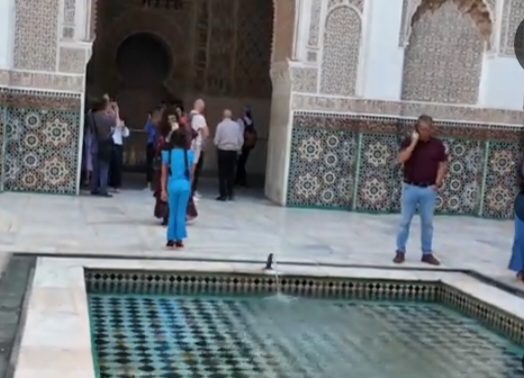
The central courtyard and marble basin
The courtyard is the heart of the building. A long central basin reflects the surrounding galleries, while the walls display several layers of traditional Moroccan decoration.
Look carefully at the different materials and techniques. The lower walls feature colourful zellige mosaics, while the sections above are decorated with carved plaster and intricate geometric and floral patterns. Higher up, carved cedar wood adds warmth and detail to the architecture.
Rather than looking at the courtyard as a single decorative space, take time to examine how these materials work together. The combination of tilework, plaster and wood is one of the most distinctive features of traditional Moroccan craftsmanship.
The carved plaster and calligraphy
One of the most impressive details is the carved plasterwork. Craftsmen created elaborate patterns using repeated geometric forms, floral motifs and Arabic calligraphy.
The decoration is not simply ornamental. It reflects a long tradition of Moroccan architectural design in which symmetry, repetition and carefully balanced proportions are central to the overall appearance.
Look at the inscriptions running along the walls and around the architectural frames. They are part of the building's artistic and religious character.
The cedar wood decoration
Carved cedar wood appears in the upper sections of the courtyard and around architectural openings. The detailed workmanship demonstrates the skill of traditional woodworkers.
The contrast between the darker wood, pale plaster and colourful zellige gives the courtyard much of its visual richness. Look upwards as well as at eye level; some of the most interesting details are found above the main decorative panels.
The prayer hall
At the far end of the courtyard is the former prayer hall. This space was an important part of the madrasa's religious and educational function.
Its decoration includes carved surfaces and calligraphic details. Take a moment to observe the transition from the open courtyard to this more enclosed interior space.
The former student rooms
The upper levels contain 134 rooms that were formerly used to accommodate students, according to the official monument website.
These rooms are much simpler than the richly decorated courtyard. Their modest size helps visitors imagine the daily routine of students who lived here while pursuing their studies.
Walk through the upper galleries and look down towards the courtyard. This perspective also reveals how the building was organised around a shared central space.
When is the best time to visit Ben Youssef Madrasa?
For a quieter experience, arriving close to the 9:00 am opening time is a sensible choice. The courtyard is often more comfortable to explore before the busiest visiting periods.
Late afternoon can also be pleasant, depending on the season and visitor numbers. During warmer months, an early visit is particularly useful because the Medina can become hot and crowded later in the day.
If photography is important to you, take time to observe how the light falls across the courtyard, the basin and the decorated walls. The appearance of the zellige and carved plaster changes throughout the day.
You can also consult our guide to the Best Time to Visit Marrakech for seasonal advice about exploring the city.
Where is Ben Youssef Madrasa located in Marrakech?
Ben Youssef Madrasa is situated on Rue Assouel, in the northern part of the old Medina, near the Ben Youssef Mosque and the Marrakech Museum.
From Jemaa el-Fna, visitors can reach the monument on foot by walking north through the souks. The route takes you through some of the traditional commercial streets of the Medina, including the area around Souk Semmarine.
The madrasa is also close to the Almoravid Koubba, one of the city's important surviving historical structures. This makes the northern Medina a worthwhile area to explore rather than simply visiting the madrasa and immediately returning to the main square.
For a wider understanding of the different areas of the old city, see our guide to Marrakech Neighbourhoods.
What else can you see near Ben Youssef Madrasa?
The northern Medina contains several places that can be combined with a visit to the madrasa.
The Almoravid Koubba
The Almoravid Koubba is located very close to Ben Youssef Madrasa. It is an important surviving example of Almoravid architecture in Marrakech and offers a different perspective on the city's earlier history.
Its architectural details and surviving decorative elements make it a useful addition for visitors interested in the development of Moroccan architecture.
Marrakech Museum
The Marrakech Museum is housed in the former Dar Menebhi Palace, close to the madrasa. The building itself is worth seeing, particularly its large central courtyard and traditional decorative features.
Depending on current exhibitions and opening arrangements, visitors can combine the museum with the madrasa for a cultural visit in the northern Medina.
The traditional souks
The souks extend through the streets south of the madrasa towards Jemaa el-Fna. They contain workshops, small commercial spaces and traditional craft businesses.
Visitors interested in local craftsmanship can discover different trades, including metalwork, leather goods, textiles, pottery, lamps and traditional household objects.
Our guide to Souk Semmarine explains more about one of the best-known commercial streets in the Medina.
Is it better to visit Ben Youssef Madrasa independently or with a local guide?
You can visit Ben Youssef Madrasa independently. The monument is accessible to visitors who want to explore the courtyard, former student rooms and architectural details at their own pace.
However, a local guide can help put the monument into a wider historical and cultural context. Understanding how the madrasa relates to the neighbouring mosque, the traditional souks and the residential streets makes the visit more meaningful.
A guided walk is also an opportunity to discover parts of the Medina that many visitors miss when following only the main commercial streets. You may encounter traditional workshops, small neighbourhood lanes, historic fondouks and everyday scenes that are not immediately visible from the main routes.
At Visit Marrakech Medina, we offer private walking experiences and small-group tours for visitors who want to explore the old city with local guidance. Some guests prefer a walk focused on history and hidden streets, while others are particularly interested in Moroccan crafts and shopping.
You can explore our Marrakech Group Tours or discover our full range of authentic Marrakech tours.
What should you know before visiting Ben Youssef Madrasa?
A few practical details can make your visit easier.
Wear comfortable walking shoes because reaching the madrasa involves walking through the Medina's narrow streets. If you are visiting during summer, carry water and try to explore earlier in the day.
Allow enough time to appreciate the courtyard and upper rooms instead of rushing through the building. The details are part of what makes the monument special.
Remember that the madrasa is a historic religious and educational site. Visitors should behave respectfully and follow any instructions given by staff.
Finally, plan your route through the surrounding souks in advance. The streets can be confusing, especially for first-time visitors, and it is useful to know the approximate opening and closing times of the shops.
Discover more of the Marrakech Medina
Ben Youssef Madrasa is one of the most beautiful historic monuments in Marrakech, but it is only one part of the old city's story. Its architecture reveals the craftsmanship of the Saadian period, while the surrounding streets offer a glimpse into the commercial and residential life of the Medina.
Exploring the area on foot gives visitors a better understanding of how these historic buildings, traditional trades and neighbourhoods fit together.
Visit Marrakech Medina, The Best Shopping and Walking Tour Company in Marrakech.
Discover our full range of authentic Marrakech tours on our homepage.