
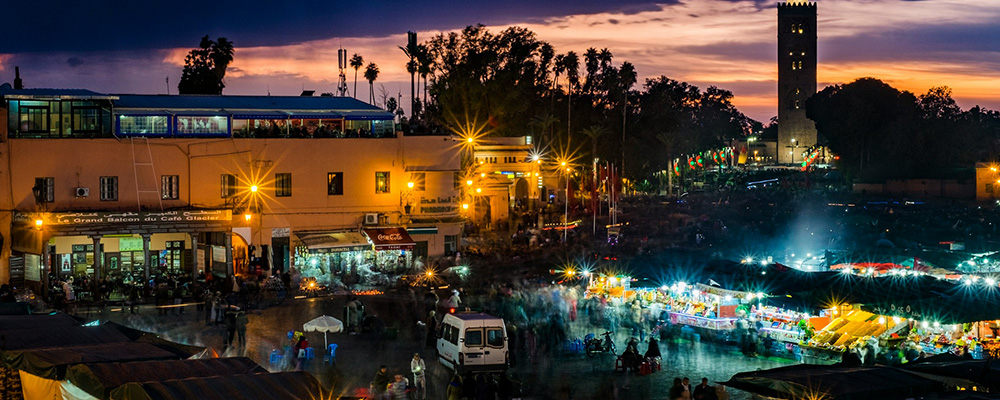
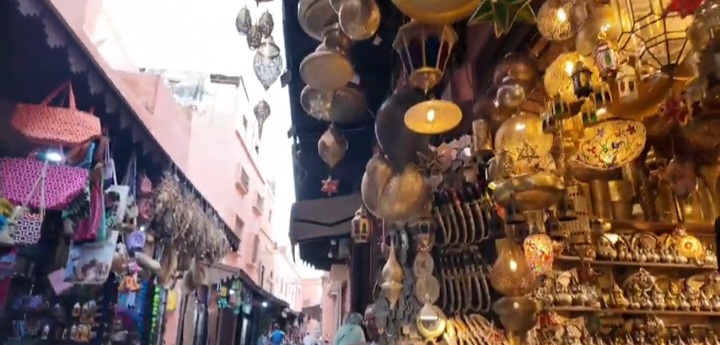
Visit Marrakech Medina, the Best Shopping and Walking Tour Company in Marrakech, has been introducing visitors to the traditional markets, history, artisans and neighbourhoods of Marrakech since 2004. Our guiding has been recommended by Rick Steves, and our Medina walking tour was recognised by Daniel Jacobs in The Rough Guide to Morocco. After more than two decades guiding visitors through the old city, we know that understanding a Moroccan souk means looking beyond the colourful products. A souk is a place where people work, trade, meet, negotiate, exchange knowledge and continue traditions that connect the past with everyday life.
To experience these markets with a local guide, begin with our Marrakech Souks Shopping Tour, which focuses on traditional shops, crafts and the experience of shopping in the Medina. Visitors interested specifically in carpets can explore our Marrakech Carpets and Rug Shopping Tour. For the wider history, architecture and neighbourhoods of the old city, see our Private Marrakech Medina Walking Tour and our Things to Do in Marrakech guide. This beginner's article explains what a souk is, how Moroccan markets work, why Marrakech has so many specialised shopping streets and what you should know before your first visit.
What Is a Souk? The Simple Definition
A souk is a traditional marketplace where people buy and sell goods.
The word comes from the Arabic word ???, written as suq, souk or souq in English.
In Morocco, a souk can be a small weekly market in a rural area, a neighbourhood food market or a large network of permanent shops and workshops inside a historic city.
This is the first thing beginners should understand: not every souk looks the same.
A rural souk may operate on a particular day of the week, bringing together farmers, livestock traders, food sellers and travelling merchants.
An urban souk, such as those in Marrakech or Fes, may consist of narrow streets filled with permanent shops, workshops and stalls.
Some souks sell many kinds of goods. Others are traditionally associated with one particular trade, such as leatherworking, metalworking, slippers, spices or carpets.
A souk is therefore both a physical marketplace and part of the economic and social life of a community.
Souks at a Glance: What Beginners Need to Know
| Question | Simple Answer |
|---|---|
| What does souk mean? | Market or marketplace in Arabic. |
| Where are souks found? | Throughout Morocco and many other Arabic-speaking countries. |
| Are souks always outdoors? | No. They can be open-air, covered, or made up of permanent shopping streets. |
| What is sold in a souk? | Food, clothing, household goods, spices, leather, textiles, carpets, jewellery and many other products. |
| Are all souks tourist markets? | No. Many primarily serve local residents and everyday needs. |
| Can visitors bargain? | Often, especially for handicrafts, but not every purchase involves negotiation. |
| Are Moroccan souks open every day? | Permanent urban souks often operate throughout the week; rural weekly souks follow market-day schedules. |
| Where are Marrakech's main souks? | In the historic Medina, especially north of Jemaa el-Fna. |
Where Does the Word Souk Come From?
The word souk comes from Arabic and refers to a marketplace.
It has different English spellings because Arabic words can be written using the Latin alphabet in several ways.
You may see:
- Souk: Common in English and French travel writing.
- Souq: Another widely used English spelling.
- Suq: A scholarly transliteration often found in academic writing.
- Souks: The English plural, referring to several markets or market sections.
In Arabic, the plural is aswaq.
Moroccans may use the word to describe a traditional market, a local commercial area or a weekly gathering of traders.
The exact meaning depends on the context.
Is a Souk the Same as a Bazaar?
The words souk and bazaar are often used in similar ways.
Both refer to marketplaces, especially in parts of North Africa, the Middle East and Asia.
However, they come from different linguistic traditions.
Souk comes from Arabic, while bazaar comes from Persian.
In Morocco, souk is the normal term.
A visitor might describe the Marrakech markets as a bazaar, but local people generally refer to them as souks.
There is no need to imagine that one word describes an indoor market and the other an outdoor market. The actual forms of these marketplaces vary widely.
What Is the Difference Between a Souk and a Medina?
This is one of the most common questions among first-time visitors to Morocco.
A medina is the historic urban centre of a Moroccan city.
It contains houses, mosques, streets, neighbourhoods, schools, workshops, markets and other buildings.
A souk is a marketplace or commercial district.
Therefore, the souks of Marrakech are part of the Marrakech Medina, but the entire Medina is not a souk.
Beyond the busy shopping streets, there are residential lanes where families live, children attend school, bread is taken to communal ovens and neighbours meet.
To understand this wider setting, read our Marrakech Medina Guide and our guide to Marrakech neighbourhoods.
How Did Moroccan Souks Begin?
Markets have existed in North Africa for many centuries.
Long before modern shopping centres, people needed places to exchange food, animals, textiles, tools and other goods.
Markets developed along trade routes, around settlements and within growing towns.
In rural areas, periodic markets allowed people from different villages to gather on an agreed day.
In cities, permanent commercial districts developed around shops, workshops and trading streets.
As Moroccan cities grew, their markets became closely connected with urban life.
Some craftspeople worked close to the places where their products were sold. Other merchants purchased goods from distant regions and brought them to city markets.
Trade was not simply an exchange of objects. It also connected communities, languages, skills and ideas.
How Did the Marrakech Souks Develop?
Marrakech was founded by the Almoravids in the eleventh century.
According to the UNESCO World Heritage Centre, the city was founded around 1070–1072 and became an important political, economic and cultural centre.
Its position helped connect different parts of Morocco with trade routes extending towards the Sahara and beyond.
Over the centuries, Marrakech developed as a place where merchants, craftspeople, residents and travellers exchanged goods.
The city's markets evolved under successive dynasties, including the Almoravids, Almohads, Saadians and Alaouites.
It would be misleading to suggest that every souk street visible today has remained unchanged since the eleventh century.
Market areas have changed, businesses have moved, buildings have been rebuilt and new products have appeared.
Nevertheless, the connection between trade, craftsmanship and the historic city remains one of the defining features of Marrakech.
Why Are the Marrakech Souks Organised by Trade?
One of the most interesting features of traditional Marrakech markets is their association with particular crafts.
Historically, certain commercial areas became known for the people who worked there or the products they sold.
For example, one area might be associated with leatherworkers, another with blacksmiths and another with slippers.
This organisation made practical sense.
Customers knew where to look for particular goods.
Craftspeople working in related trades could share knowledge, tools, suppliers and commercial relationships.
Some activities also required particular working conditions.
However, the modern souks are not perfectly divided into separate crafts.
A street historically associated with one trade may now contain many different kinds of shops.
The traditional names remain important clues to the commercial history of the Medina.
What Are the Main Souks of Marrakech?
Visitors often speak about the Marrakech souk as though it were one large market.
In reality, it is a network of connected commercial streets and specialised areas.
Here are some important names to recognise.
Souk Semmarine: A Main Shopping Street
Souk Semmarine is one of the principal commercial routes in the Marrakech Medina.
It connects the area near Jemaa el-Fna with the deeper shopping streets.
Visitors can find textiles, clothing, slippers, lanterns, decorative objects and many other products.
It is a useful place to begin understanding how the souks are organised.
However, because it is a busy commercial route, the experience can differ from quieter artisan lanes.
Souk Smata: Traditional Moroccan Slippers
Souk Smata is associated with Moroccan slippers, commonly called babouches.
Traditional slippers may be made from leather and decorated in different ways.
Some are designed for everyday use, while others are intended for special occasions.
When comparing slippers, examine the stitching, material, sole and finishing.
Souk Cherratine: Leatherworking
Souk Cherratine is traditionally associated with leatherworkers.
Leather goods found in Marrakech include bags, belts, wallets, poufs and other accessories.
Not everything sold as leather is made using the same material or technique.
It is useful to ask whether an item is genuine leather, what type of leather was used and whether the work was completed by hand or machine.
Souk Haddadine: Blacksmiths and Metalwork
Souk Haddadine is associated with blacksmiths and metalworking.
Traditional metalworking has supplied households and buildings with practical objects as well as decorative pieces.
Visitors may encounter workshops where metal is cut, shaped or finished.
The tools, sounds and working methods help explain the difference between a shop displaying finished products and a workshop where objects are actually made.
Souk El Attarine: Perfumes, Spices and Changing Trades
The name Attarine is associated historically with perfumers and sellers of aromatic goods.
Today, the surrounding commercial area also includes metalwork, lamps and decorative products.
This is a useful example of how traditional market names can survive even when the products sold in a street change.
Souk Zrabia: Carpets and Rugs
Souk Zrabia, also written Souk Zrabi, is associated with carpets and rugs.
Marrakech has long served as a trading centre for textiles produced in different regions of Morocco.
Visitors may see wool pile rugs, flatwoven textiles, colourful Azilal rugs, Beni Ourain styles and other regional products.
For a deeper explanation of materials, regional origins and buying considerations, explore our Marrakech Carpets and Rug Shopping Tour.
Souk Sebbaghine: Traditional Dyers
The name Sebbaghine refers to dyers.
Textile dyeing is an important stage in the production of many traditional woven goods.
Depending on the material and method, yarn or cloth may be dyed before or after weaving.
The traditional dyers' area reflects the historical importance of textile preparation in Marrakech.
Do not assume that every coloured textile sold in the souks has been dyed locally or with natural dyes.
Souk Nejjarine: Woodworking
Nejjarine is associated with carpenters and woodworkers.
Moroccan woodworking includes furniture, doors, boxes, architectural details and decorative objects.
Some pieces are carved or assembled by hand, while others involve modern machinery.
Understanding the material and construction helps buyers evaluate workmanship.
Rahba Kedima: A Historic Market Square
Rahba Kedima is a historic square in the central Medina.
Visitors encounter baskets, spices, herbal products and other goods in and around the area.
It is also an important point for understanding the geography of the souks.
From here, different lanes lead towards commercial streets and neighbourhoods.
The square is a useful place to stop, observe the surroundings and regain your bearings.
What Can You Buy in a Moroccan Souk?
The range of products depends on the city, region and type of market.
In Marrakech, visitors encounter both everyday household goods and products intended for travellers.
| Product | What to Examine |
|---|---|
| Moroccan rugs | Wool, weaving, dimensions, condition and origin. |
| Leather bags | Material, stitching, lining, hardware and finishing. |
| Babouche slippers | Fit, sole, leather, stitching and comfort. |
| Lanterns | Metal, joints, finish, electrical compatibility and packing. |
| Pottery | Intended use, glaze, cracks, stability and food safety. |
| Spices | Freshness, identity, packaging and storage. |
| Argan oil | Ingredients, intended use, packaging and producer information. |
| Textiles | Fibres, weaving, embroidery, dimensions and care. |
| Jewellery | Metal content, hallmarks where applicable, stones and provenance. |
| Wooden objects | Wood species, construction, finishing and export restrictions. |
Visitors should remember that a product sold in Morocco is not necessarily manufactured in Morocco.
Imported goods, locally manufactured products and traditional handmade objects can appear side by side.
For more information about the different commercial areas, see our Essential Guide to Marrakech's Souks.
What Is a Hanout? Understanding Traditional Moroccan Shops
A hanout is a small shop.
The word is widely used in Morocco for neighbourhood shops selling groceries and everyday necessities, but it can also refer more generally to a small commercial premises.
In a traditional market, a small shop may occupy a narrow space with goods displayed on shelves, hanging from the walls or arranged near the entrance.
Some shopkeepers sell products made elsewhere.
Others work directly with artisans or produce certain goods themselves.
A shop and a workshop are not always the same thing.
This distinction matters when someone tells you that an object is handmade.
The question is not simply whether the shop looks traditional. It is where and how the object was actually produced.
Who Are the Artisans of the Moroccan Souks?
Artisans are people who make or finish products using practical craft skills.
In Morocco, these skills include leatherworking, weaving, woodworking, metalworking, pottery, embroidery and many other trades.
An experienced master craftsperson may be called a maâlem.
The title is associated with recognised skill and knowledge within a trade.
Traditionally, craft knowledge could be passed from experienced workers to apprentices through observation, practice and repeated work.
Not every craftsperson follows the same training path today.
Some work in family businesses, others in independent workshops, cooperatives or modern production facilities.
When visiting a workshop, pay attention to the actual process.
For example, a metalworker shaping a piece by hand is demonstrating a different stage of production from a merchant selling finished lanterns.
Both have a role in the market, but their work is different.
What Is a Fondouk and Why Is It Connected to the Souks?
A fondouk, also written funduq, is a historic type of commercial building associated with merchants, storage and sometimes accommodation.
Traditional fondouks often have rooms arranged around an internal courtyard.
They played a role in commercial life by providing space for goods, traders and related activities.
In Marrakech, some historic fondouks have been adapted for workshops, cultural uses or other purposes.
They are important because they show that trade was not limited to the shopfronts visible along market streets.
Behind the commercial lanes were buildings that supported storage, production and movement of goods.
UNESCO specifically recognises souks, fondouks, artisanal activities and traditional trades as part of the historic urban character of Marrakech.
How Do Moroccan Souks Work Today?
Modern souks combine old trading practices with contemporary business.
Some shopkeepers purchase stock from wholesalers.
Others order products from workshops or work directly with makers.
Some artisans produce and sell from the same premises.
Payment may be made in cash, by card or through other arrangements, depending on the business.
Prices may be fixed, negotiable or quoted according to the particular item.
Tourism is important to many shops in central Marrakech, but the souks also serve local residents.
Moroccan customers continue to purchase clothing, household products, food, tools and services within traditional market areas.
The souks are therefore living commercial spaces, not museums created exclusively for tourists.
Why Do People Bargain in Moroccan Souks?
Bargaining is a familiar part of shopping in many traditional Moroccan markets.
However, it is not compulsory for every purchase.
In some shops, prices are clearly displayed and treated as fixed.
In others, particularly when purchasing certain handicrafts, the initial asking price may be open to negotiation.
Negotiation allows the buyer and seller to discuss a price they both consider acceptable.
It can also involve questions about quality, size, materials, quantity or delivery.
For visitors, the most useful approach is to understand the product before focusing on the discount.
How to Bargain Respectfully in a Marrakech Souk
- Look around first. Compare similar products in more than one shop.
- Ask about quality. Find out what the object is made from and how it was produced.
- Know your budget. Decide what you can comfortably spend.
- Ask the price politely. A simple question is enough to begin.
- Make a reasonable offer. Base it on the product and your comparisons rather than an invented universal discount rule.
- Stay friendly. Negotiation should not become an argument.
- Confirm the final amount. Make sure both sides understand the price and currency.
- Be prepared to leave politely. You are not obliged to purchase.
There is no reliable rule that every Marrakech souk price should be reduced by half or by a particular percentage.
A fair price depends on the item, its quality, the seller and the circumstances.
Do You Have to Buy Something After Entering a Souk Shop?
No.
Entering a shop does not create an obligation to buy.
You can ask questions, examine products and decide not to purchase.
Accepting a glass of mint tea does not automatically create a purchase obligation either.
However, it is considerate to be clear about your intentions.
If you are only looking, you can say so politely.
For expensive items such as carpets, take enough time to examine the product and understand the terms of sale.
Never make a major purchase simply because you feel uncomfortable saying no.
Useful Moroccan Arabic Words for Shopping
Learning a few words of Moroccan Arabic, commonly called Darija, can make shopping more enjoyable.
| Expression | Meaning |
|---|---|
| Salam alaykum | Hello; peace be upon you. |
| Shukran | Thank you. |
| La, shukran | No, thank you. |
| Bshhal? | How much? |
| Ghali | Expensive. |
| Wakha | Okay. |
| Bslama | Goodbye. |
Pronunciation varies, and many Marrakech merchants also speak French, English or other languages.
A friendly greeting and respectful attitude are more important than perfect pronunciation.
Are All Moroccan Souks Tourist Markets?
No, and this distinction is essential.
Some souks mainly serve local households.
Others have become popular with international visitors.
In Marrakech, the central handicraft streets attract many tourists, but nearby markets also sell vegetables, meat, bread, clothing, household supplies and everyday goods.
These local markets reveal another side of commercial life.
A resident buying ingredients for dinner is using the market differently from a traveller choosing a decorative lantern.
Both are part of the same wider urban economy.
For visitors interested in quieter commercial streets, our guide to hidden souks most tourists miss explores less obvious parts of the Medina.
What Is a Weekly Souk in Morocco?
A weekly souk is a market that takes place on a particular day of the week.
These markets are especially important in rural areas and smaller towns.
Farmers, traders and residents may travel from surrounding villages to buy and sell goods.
Depending on the market, products may include vegetables, grain, livestock, clothing, tools and household supplies.
Some weekly markets are named after the day on which they take place.
For example, names containing Souk El Had are associated with Sunday, while Souk El Khemis refers to Thursday.
The specific schedule should always be checked locally.
A weekly rural souk is not the same as the permanent network of shops found in the centre of Marrakech.
What Is the Difference Between a Souk, a Shop and a Cooperative?
These words describe different kinds of commercial activity.
A souk is a market or market district.
A shop is an individual business selling products.
A workshop is a place where products are made, repaired or finished.
A cooperative is an organisation in which members work together under a particular ownership and management structure.
A cooperative may produce goods, sell them or do both.
However, a sign saying "cooperative" does not by itself prove how a business is legally organised or how its workers are paid.
When buying from any business, ask direct questions about the products and the organisation if these details matter to you.
How Can You Tell Whether a Souk Product Is Handmade?
There is no universal test for every product.
The evidence depends on the material and the manufacturing process.
For a rug, examine the weaving.
For leather goods, look at the stitching, edges and construction.
For metalwork, examine the joints, surface decoration and finishing.
For pottery, look at the form, glaze and signs of the production method.
Remember that handmade products may involve tools or machines at certain stages.
The useful question is not whether every step was completed without equipment, but which parts were made by hand and what skills were involved.
Do not assume that an uneven surface automatically proves authenticity.
Likewise, a neatly finished object is not necessarily factory-made.
What Are the Opening Hours of the Marrakech Souks?
The Marrakech souks do not have one official opening and closing time.
Each shopkeeper manages their own business hours.
As a general guide, many shops begin opening around 9:00 or 10:00 in the morning.
Many close around 7:00 or 8:00 in the evening, although shops in busy tourist areas may remain open later.
Food markets and certain workshops may follow different schedules.
Friday prayers, Ramadan, religious holidays and seasonal conditions can also affect opening hours.
For a detailed explanation, read our complete local guide to Marrakech souk opening and closing hours.
What Is the Best Time to Visit a Moroccan Souk?
The best time depends on what you want to experience.
Morning: Good for Learning and Comparing
Morning is often a good choice for visitors who want to examine products and ask questions without feeling rushed.
Some artisan workshops may already be active.
It can also be more comfortable during warmer months.
Afternoon: A Livelier Shopping Experience
By afternoon, many market streets are busy with shoppers, deliveries and commercial activity.
This is a good time to experience the atmosphere of the souks.
Evening: Lights and Busy Streets
Some commercial areas near Jemaa el-Fna remain lively after sunset.
However, smaller workshops and deeper market streets may close earlier.
For a serious shopping visit, do not rely on every shop remaining open late.
Are Marrakech Souks Open on Friday and During Ramadan?
Many Marrakech shops operate on Fridays, but some close temporarily around congregational prayer.
During Ramadan, business hours may change.
Some shops open later, reduce their afternoon activity or reopen after the evening meal.
There is no universal Ramadan schedule for every business.
If you need to visit a particular shop, confirm its hours directly.
Where Are the Marrakech Souks Located?
The best-known traditional shopping streets are inside the historic Medina, especially to the north of Jemaa el-Fna.
Souk Semmarine provides a useful route into the central commercial area.
Rahba Kedima, the Mouassine area and the streets around the Ben Youssef district help visitors understand the wider market geography.
However, traditional commerce is not limited to this central zone.
Other neighbourhoods have food markets, small shops and local commercial streets.
It is helpful to think of Marrakech as a living city with several types of markets rather than one enormous souvenir bazaar.
Google Maps: Important Marrakech Souk Locations
These Google Maps links can help you locate the main commercial areas.
- Jemaa el-Fna — central starting point for the souks.
- Souk Semmarine — main shopping street.
- Rahba Kedima — historic market square.
- Souk Smata — traditional slipper market.
- Souk Haddadine — traditional metalworking area.
- Criée Berbère — historic carpet-trading area.
- Ben Youssef Madrasa — historic landmark near the northern souks.
Walking Directions and Distances to the Marrakech Souks
The following links open Google Maps walking directions, including current route estimates and distances.
- Jemaa el-Fna to Souk Semmarine — walking directions and distance.
- Jemaa el-Fna to Rahba Kedima — walking directions and distance.
- Rahba Kedima to Souk Smata — walking directions and distance.
- Rahba Kedima to Criée Berbère — walking directions and distance.
- Ben Youssef Madrasa to Souk Semmarine — walking directions and distance.
- Bahia Palace to Rahba Kedima — walking directions and distance.
The narrow passages of the Medina can make navigation challenging. Google Maps estimates may not always reflect temporary obstructions, local access conditions or the most convenient pedestrian route.
A Simple First-Time Walking Route Through the Marrakech Souks
For a first visit, begin at Jemaa el-Fna.
Enter the main shopping streets through the Souk Semmarine area.
Continue towards the central market lanes, stopping to examine different products and understand how the commercial streets connect.
Make your way towards Rahba Kedima, where you can observe a historic square surrounded by shops and trading activity.
From there, explore nearby craft streets according to your interests.
If you enjoy traditional architecture, continue towards the Ben Youssef district.
If you prefer a more structured route, our Secret Loop Marrakech Medina Walk explains how to connect market streets with historic neighbourhood landmarks.
Allow approximately two to three hours for a relaxed introduction, with additional time if you plan to compare products or visit workshops.
Can You Visit the Marrakech Souks Without Buying Anything?
Absolutely.
Walking through the souks can be a cultural experience in its own right.
You can observe architecture, listen to workshops, learn the names of traditional trades and see how everyday commercial life continues.
However, the souks are working environments.
Respect shopkeepers, artisans, residents and people moving goods through narrow streets.
Ask permission before photographing people or their workplaces.
Do not block entrances or interrupt someone using tools simply to take a picture.
Are the Marrakech Souks Safe for First-Time Visitors?
The main souk streets are generally busy with residents, merchants and visitors.
As in other crowded urban shopping areas, sensible precautions are important.
- Keep valuables secure and remain aware of your belongings.
- Use comfortable shoes suitable for uneven streets.
- Be careful around motorcycles, bicycles and delivery carts.
- Do not follow strangers into unfamiliar places because of urgent claims about a closed street or special sale.
- Agree on prices before accepting paid services.
- Keep the location of your accommodation saved on your phone.
- Use established landmarks when navigating.
If you feel lost, return to a main commercial street or ask for directions from a shopkeeper.
There is no need to be frightened of the souks, but it is wise to remain attentive.
What Are Common Shopping Mistakes in Moroccan Souks?
Many shopping disappointments come from misunderstanding the product or the terms of the sale.
Buying Before Comparing
Look at more than one example of a product before deciding.
Assuming Everything Is Handmade
Ask about materials, production and origin.
Focusing Only on Discounts
A large discount does not prove that the final price is good value.
Not Checking Dimensions
This is especially important for rugs, furniture, lanterns and large decorative objects.
Ignoring Shipping Costs
Ask about packaging, delivery, insurance and customs before making a large purchase.
Feeling Obliged to Buy
You can always decline politely.
Confusing a Shop's Story With Documentation
Claims about an object's age, origin or rarity should be supported when those details affect its value.
How Should You Pay in a Marrakech Souk?
The Moroccan dirham is the local currency.
Cash remains useful in many small shops and market stalls.
Some larger businesses accept payment cards, but you should not assume every seller does.
Before paying, confirm the price, currency and what is included.
For expensive items, request a receipt describing the purchase.
If shipping is arranged, keep written confirmation of the delivery terms.
Be cautious when transferring money to unfamiliar accounts or paying for goods that will be delivered later without clear documentation.
How Are Moroccan Souks Different From Modern Shopping Malls?
A shopping mall usually has a centrally managed building, standardised opening hours and a collection of individual retailers.
A traditional souk is more closely integrated into the streets and everyday life of the city.
In Marrakech, a commercial lane may connect directly with a residential neighbourhood, a mosque, a historic fountain or an artisan workshop.
Shop sizes vary, and businesses operate independently.
Some products are made nearby, while others arrive through national or international supply chains.
Prices and shopping customs may differ between businesses.
The souk is therefore not simply an older version of a shopping mall. It reflects a different relationship between commerce, urban space and community life.
Why Are Moroccan Souks Important to Local Culture?
Souks provide livelihoods for merchants, craftspeople, suppliers, transport workers and many others.
They also help maintain knowledge about materials, manufacturing and traditional trades.
For local residents, markets provide practical goods and services.
For visitors, they offer opportunities to understand Moroccan commercial traditions.
But the cultural importance of the souks does not mean every shop is ancient or every product is traditional.
Modern materials, changing customer preferences and international trade are part of the current market economy.
The continuing value of the souks lies partly in their ability to adapt while preserving important elements of local commercial life.
How Is Tourism Changing the Marrakech Souks?
Tourism has created demand for carpets, lanterns, leather goods, pottery, jewellery and decorative textiles.
This can support businesses and create opportunities for craftspeople.
It can also encourage the production of items designed mainly for visitors rather than local household use.
Some workshops adapt traditional skills to contemporary designs.
Other businesses sell imported products that imitate Moroccan crafts.
These developments make it increasingly important to understand the difference between an object's appearance, production method and origin.
A visitor who asks informed questions is better prepared to appreciate genuine workmanship without relying on romantic stories about the past.
Is a Guided Souk Shopping Tour Worth It?
A guided shopping tour can be useful if you want to understand the souks rather than simply walk through them.
A knowledgeable local guide can explain traditional market names, identify different craft techniques and help you compare products.
A guide may also help you navigate unfamiliar streets and communicate with sellers.
However, not every visitor needs a guide.
If you enjoy exploring independently, have plenty of time and are comfortable asking questions, you can discover much on your own.
Before booking a shopping guide, ask what the tour includes, whether shopping is optional and whether the guide receives commissions or referral payments from shops.
These details help you choose an experience that suits your expectations.
Discover the Marrakech Souks With Visit Marrakech Medina
At Visit Marrakech Medina, our experience guiding visitors since 2004 has taught us that the most rewarding souk visits begin with curiosity.
Instead of asking only where to buy something, it is worth asking how the product was made, who uses it, what materials are involved and why a particular market street became associated with that trade.
That is how a shopping experience becomes an introduction to the culture and history of Marrakech.
Our Private Marrakech Souks Shopping Tour is the most relevant experience for visitors who want to explore the markets and learn about traditional products.
If your main interest is handmade carpets, choose our Marrakech Carpets and Rug Shopping Tour.
For travellers who prefer to focus on monuments, architecture and the history of the old city, our Private Marrakech Medina Walking Tour offers a broader cultural experience.
Our standard historical walking tours do not require compulsory shopping stops. For those standard private walking tours, no advance payment is required and payment is made at the end.
Explore Our Marrakech Souks Shopping Tour
Frequently Asked Questions About Moroccan Souks
What does souk mean in English?
Souk means market or marketplace. The word comes from Arabic.
What is a Moroccan souk?
A Moroccan souk is a traditional marketplace. It may be a permanent urban shopping district, a neighbourhood market or a weekly rural market.
What is the difference between souk and souq?
They are different English spellings of the same Arabic word.
What is the difference between a souk and a bazaar?
Both describe marketplaces, but souk comes from Arabic and bazaar comes from Persian.
Are Moroccan souks only for tourists?
No. Many markets serve local residents who buy food, clothing, household goods and everyday necessities.
Why are Marrakech souks famous?
They are known for their network of historic shopping streets, traditional crafts, varied products and lively commercial atmosphere.
Where are the Marrakech souks?
The best-known central souks are in the historic Medina, particularly north of Jemaa el-Fna.
Do you have to pay to enter the Marrakech souks?
No. The traditional market streets are public commercial areas and do not have a general admission fee.
Are the Marrakech souks open every day?
Many permanent shops operate throughout the week, but individual opening hours and days vary.
What time do Marrakech souks open?
Many shops open around 9:00 or 10:00 in the morning, although individual schedules differ.
Can you bargain in Moroccan souks?
Yes, bargaining is common for certain products, particularly handicrafts. However, some businesses have fixed prices.
Do you need cash in the Marrakech souks?
Cash in Moroccan dirhams is useful, especially for smaller shops. Some businesses also accept cards.
What is the best thing to buy in Marrakech?
That depends on your interests. Visitors often look for rugs, leather goods, slippers, ceramics, lanterns, spices and textiles.
Are products in Marrakech souks handmade?
Some are handmade, others are partly machine-produced, and some are imported. Ask about the production method and origin.
Is it safe to walk through the Marrakech souks alone?
Many visitors explore independently. Keep valuables secure, stay aware of traffic and crowds, and use reliable landmarks for navigation.
Can you visit the souks without shopping?
Yes. Visitors can explore the market streets, observe architecture and learn about crafts without buying anything.
How long should I spend in the Marrakech souks?
Allow at least two to three hours for a relaxed introduction. Serious shopping or workshop visits may take longer.
What is the difference between a souk and a hanout?
A souk is a marketplace or market district. A hanout is a small shop.
What is a maâlem?
A maâlem is an experienced master craftsperson, a term associated with skilled traditional trades.
What is a fondouk?
A fondouk is a historic commercial building associated with merchants, storage and sometimes accommodation.
Are the Marrakech souks part of a UNESCO World Heritage Site?
Yes. The Medina of Marrakech was inscribed on the UNESCO World Heritage List in 1985. Its souks, traditional trades and historic urban form contribute to its cultural significance.
Can I book a private Marrakech souk shopping tour?
Yes. Visit Marrakech Medina offers a private Marrakech Souks Shopping Tour for visitors who want to discover traditional markets and learn about Moroccan crafts and shopping.
Final Thoughts: A Souk Is More Than a Place to Shop
So, what is a souk?
At its simplest, a souk is a marketplace.
But in Morocco, the word can describe much more than a collection of stalls.
A souk brings together merchants, craftspeople, customers, goods and services.
It connects everyday needs with regional production and long-established trading practices.
In Marrakech, the souks are also part of the historic fabric of the Medina.
Understanding them begins with simple questions: What is sold here? Who makes it? Where does it come from? Why is this street associated with a particular trade?
Once you begin asking these questions, the Marrakech souks become easier to understand.
You no longer see only a maze of shops. You begin to recognise a network of commercial streets, workshops, neighbourhoods and traditions.
Whether you plan to buy something or simply explore, learning how the souks work can make your visit more meaningful.
Ready to discover Marrakech's traditional markets? Explore our Marrakech Souks Shopping Tour and experience the commercial heart of the Medina with a local guide.
Continue Exploring Marrakech's Souks
- An Essential Guide to Marrakech's Souks — explore the main market areas and their products.
- Hidden Souks Most Tourists Miss — discover lesser-known commercial streets.
- Marrakech Souk Opening Hours — plan your visit by day and season.
- The Secret Loop Marrakech Medina Walk — connect markets with historic streets and neighbourhoods.
- Marrakech Medina Guide — understand the wider historic city.
- Marrakech Carpets and Rug Shopping Tour — learn about one of Morocco's most important textile traditions.
Historical Sources and Further Reading
This guide combines practical Marrakech guiding knowledge with published information about Moroccan markets, urban history and traditional crafts. The following sources are useful for further research.
- UNESCO World Heritage Centre — Medina of Marrakesh. UNESCO documents the city's foundation, historic importance, urban structure, souks, fondouks and traditional trades. Read the UNESCO World Heritage description.
- UNESCO Institute for Lifelong Learning — Marrakech city brochure. The publication discusses Marrakech's traditional crafts and the organisation of specialised souks, including leatherworkers, carpet sellers, dyers and metalworkers. Read the Marrakech brochure (PDF).
- Moroccan National Tourist Office — Magnificent Medinas. This publication describes Morocco's historic medinas, artisan shops, traditional products and the Marrakech souks. Read the Moroccan medinas brochure (PDF).
- Clifford Geertz and Lawrence Rosen — Suq: The Bazaar Economy in Sefrou. A scholarly study of the social relationships and trading practices of a Moroccan marketplace. It concerns Sefrou rather than Marrakech, so it is useful for wider Moroccan market context, not as proof of specific Marrakech street histories. Read the scholarly publication (PDF).
- Visit Marrakech Medina — Marrakech Medina Guide. Additional information about the geography of Marrakech's traditional commercial streets and specialised market areas. Read our Marrakech Medina Guide.
About this guide: Prepared for Visit Marrakech Medina, a Marrakech-based guiding service operating since 2004. The article is intended to help first-time visitors understand Moroccan souks, traditional commerce, craftsmanship, market etiquette and practical navigation. Historical descriptions are distinguished from present-day shopping practices, which can change over time.