
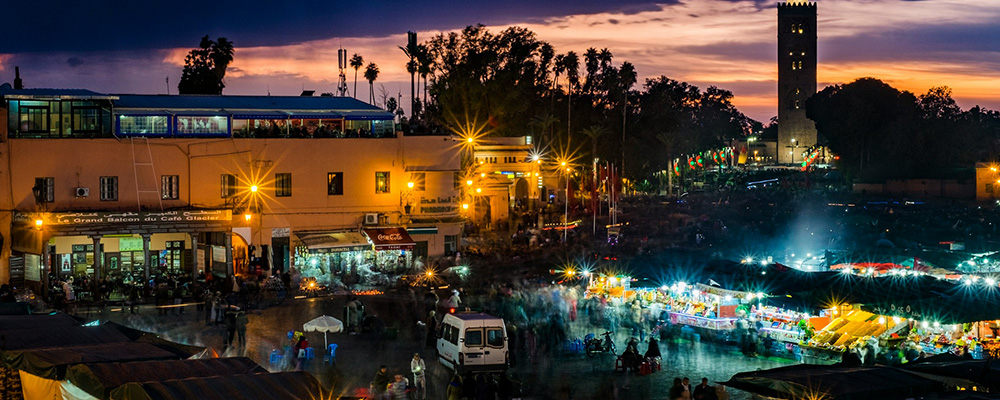
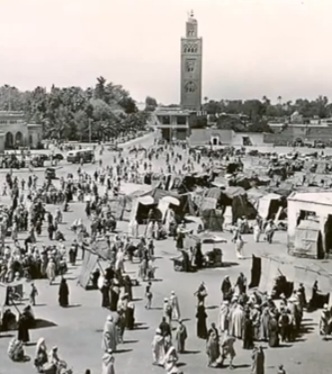
Visit Marrakech Medina, the Best Shopping and Walking Tour Company in Marrakech, has been introducing visitors to the history, traditional markets, artisans and neighbourhoods of Marrakech since 2004. Our guiding has been recommended by Rick Steves, and our Medina walking tour was recognised by Daniel Jacobs in The Rough Guide to Morocco. After more than two decades of guiding visitors through the old city, one of the most interesting questions we hear is how the Marrakech souks began. To understand these markets, we must go back almost one thousand years, to the Almoravids, the dynasty that founded Marrakech and helped transform it into a major centre of trade, government and urban life.
Visitors who want to discover this commercial history can begin with our Marrakech Souks Shopping Tour, which explores the traditional markets, products and craftsmanship of the Medina. For a closer look at one of Morocco's important textile traditions, see our Marrakech Carpets and Rug Shopping Tour. Visitors interested in the wider history and architecture of the city can explore our Private Marrakech Medina Walking Tour and our Things to Do in Marrakech guide. This article explains who the Almoravids were, why they founded Marrakech, how their new capital developed economically and what remains of their city today.
How Did the Marrakech Markets Begin?
The history of the Marrakech souks begins with the foundation of the city by the Almoravids in the eleventh century.
According to UNESCO, Marrakech was founded between 1070 and 1072.
The Almoravids established a new political centre that gradually became an important capital connecting different parts of Morocco, the Sahara and the western Mediterranean.
As the settlement grew, it needed places where residents, soldiers, merchants and craftspeople could obtain food, clothing, equipment and everyday supplies.
Trade and the growth of the city were closely connected.
However, there is an important historical distinction.
The Almoravids laid the foundations of Marrakech as a commercial city, but this does not mean that every souk street we see today was already operating under its present name in the eleventh century.
The specialised markets of Marrakech developed and changed through several dynasties and many generations of merchants.
The best way to understand the Almoravid contribution is to see how they created the political, geographical and economic conditions that allowed Marrakech's markets to grow.
The Almoravids and Marrakech at a Glance
| Historical Question | Answer |
|---|---|
| Who were the Almoravids? | An Amazigh-led political and religious movement that developed into a powerful dynasty. |
| When was Marrakech founded? | Around 1070 to 1072. |
| Who were the main early rulers? | Abu Bakr ibn Umar, Yusuf ibn Tashfin and Ali ibn Yusuf. |
| Why was Marrakech important? | It became a political capital and an important centre of trade and urban development. |
| What supported its commercial growth? | Regional trade, Saharan connections, government activity, population growth and craft production. |
| When were the early city walls built? | In 1126 to 1127, under Ali ibn Yusuf. |
| What Almoravid monument survives? | The Almoravid Koubba near the Ben Youssef area. |
| When did Almoravid rule end in Marrakech? | In 1147, when the Almohads captured the city. |
Who Were the Almoravids?
The Almoravids were a political and religious movement that emerged among Amazigh communities connected with the western Sahara during the eleventh century.
They are associated especially with the Sanhaja tribal confederation.
At the beginning, their power developed through religious reform, military organisation and alliances among communities.
Over time, the movement expanded into a dynasty that controlled large territories in North Africa and parts of the Iberian Peninsula.
The Almoravids were not simply a group of merchants, and their history cannot be reduced to trade alone.
They were rulers, military leaders and builders of a major political state.
Nevertheless, control of important commercial routes and resources contributed to their power.
Their expansion helped connect regions that were already participating in long-distance trade.
For Marrakech, this created an opportunity to develop from a new settlement into a major capital.
Why Did the Almoravids Choose Marrakech?
Marrakech was not chosen randomly.
The site stood in the Haouz plain, with the High Atlas Mountains to the south and important routes connecting different parts of Morocco.
It offered access to agricultural land, regional movement and the wider trading networks of the country.
The surrounding landscape also made it possible to support a growing urban population.
Before Marrakech became a major city, other settlements and trading centres already existed in the region.
Aghmat, located towards the foothills of the High Atlas, was an important earlier commercial centre.
The creation of Marrakech did not mean that all trade immediately abandoned Aghmat or other existing markets.
Instead, the rise of a new political capital gradually changed the balance of economic activity.
As rulers, officials, soldiers, craftspeople and merchants became concentrated in Marrakech, the city developed its own demand for goods and services.
This was one of the basic reasons its markets could expand.
Abu Bakr ibn Umar and the Foundation of Marrakech
Abu Bakr ibn Umar was an important leader of the early Almoravid movement.
Historical accounts connect him with the establishment of the Almoravid presence at the site of Marrakech.
Yusuf ibn Tashfin later became the central figure in developing the settlement into a major capital.
The exact details of the foundation are not described identically in every historical source.
For this reason, it is better to use the accepted foundation period of approximately 1070 to 1072 rather than insist that every stage of the city's creation happened on one precise day.
UNESCO's historical documentation identifies the early Almoravid settlement and the role of Yusuf ibn Tashfin in transforming it into a capital.
At first, Marrakech was not the densely built Medina we know today.
Its urban structure developed as the Almoravid state grew.
Yusuf ibn Tashfin and the Growth of the New Capital
Yusuf ibn Tashfin was one of the most important figures in the early history of Marrakech.
Under his leadership, the Almoravid state expanded its authority across much of Morocco and beyond.
Marrakech developed as a political and administrative centre.
Government activity attracted people and resources.
A growing capital needed food, water, building materials, clothing, animals, tools and skilled workers.
These requirements created commercial opportunities.
Farmers and suppliers could bring food and raw materials into the city.
Craftspeople could produce goods for residents and institutions.
Merchants could connect the capital with regional and long-distance trading networks.
We should not imagine that Yusuf ibn Tashfin personally designed all the modern souks.
His historical importance lies in the development of the city and the state that supported its early economic growth.
What Did an Early Almoravid Market Look Like?
It is tempting to imagine that an eleventh-century Marrakech market looked exactly like Souk Semmarine today.
But there is not enough evidence to reconstruct every early market street, shopfront and trading area with that level of precision.
We know that the new capital needed commercial activity.
We also know that medieval North African cities contained markets, workshops and places where merchants exchanged goods.
However, the exact organisation of the earliest Marrakech markets is less securely documented than the history of the city's foundation and major surviving monuments.
A reasonable picture of early commercial life includes the exchange of food, animals, textiles, tools and other necessities.
These are the kinds of goods required by a growing medieval city.
But we should distinguish this general understanding from a claim that a particular modern souk was founded in a specific year by an Almoravid ruler.
There is no sound reason to assign an eleventh-century foundation date to every present-day Marrakech craft market.
How Did the Sahara Influence Marrakech's Early Markets?
The Sahara played an important role in the history of the Almoravid state.
Long before Marrakech was founded, trading networks connected parts of North Africa with communities south of the Sahara.
These routes carried goods and connected merchants across long distances.
Gold was one of the most important commodities associated with the wider trans-Saharan economy.
Other traded goods included salt, textiles and various regional products.
The Almoravids gained influence over important parts of these commercial networks.
Modern historical and archaeological research has examined the relationship between Almoravid expansion, gold circulation and coin production.
For Marrakech, the significance was not simply that caravans existed.
The city became a capital within a state that controlled or influenced major territories and commercial connections.
This helped place Marrakech within a wider economic system extending beyond the Haouz plain.
Did All Saharan Caravans Travel Directly to Marrakech?
No.
This is an important point because tourism descriptions sometimes simplify the history.
Trans-Saharan trade did not follow one single road leading directly to Marrakech.
It involved different routes, trading settlements, intermediaries and regional markets.
Sijilmasa, in southeastern Morocco, was one of the important historic centres associated with Saharan commerce.
Goods could move through several stages before reaching other Moroccan cities.
Marrakech benefited from its position within these wider political and commercial networks.
But it would be misleading to describe every caravan as travelling directly from West Africa to a particular souk in the Marrakech Medina.
Understanding these networks helps explain why medieval trade was more complex than the familiar image of a camel caravan arriving at a market gate.
What Goods Were Important in the Early Marrakech Economy?
The economy of an early medieval capital depended on many types of goods.
Food and Agricultural Products
A growing population needed grain, vegetables, fruit, meat and other basic supplies.
Trade with the surrounding countryside was essential to urban life.
Not every product came from a distant caravan route.
Much of the daily economy depended on nearby agricultural production.
Wool and Textiles
Wool was an important raw material in Morocco.
It could be used to produce clothing, blankets and other woven textiles.
Textile production required several skills, including fibre preparation, spinning, weaving and sometimes dyeing.
These activities formed part of the wider craft economy.
However, today's named Moroccan rug styles should not automatically be projected back to the Almoravid period.
Leather and Animal Products
Leather was useful for footwear, bags, straps, equipment and many other practical objects.
Its production involved specialised skills and different stages of preparation.
Leatherworking became an important feature of Moroccan urban craft traditions.
Metal Goods and Tools
Metalworkers supplied tools, household objects and equipment needed by residents and other craftspeople.
Construction and agriculture also required practical metal goods.
Building Materials
The growth of a capital required timber, earth-based building materials, stone, lime and other construction supplies.
Buildings, water facilities and defensive structures created demand for skilled labour.
Gold and Coinage
Gold played a significant role in the wider Almoravid economy.
The dynasty is particularly associated with gold coin production and the circulation of currency across its territories.
Research into Almoravid coins helps historians understand economic connections between North Africa, the Sahara and the Iberian Peninsula.
Why Was Gold Important to the Almoravids?
Gold was important because it supported monetary activity and long-distance exchange.
Almoravid gold coins circulated across a wide area.
Coins are especially useful historical evidence because they can provide information about rulers, minting locations and economic connections.
Archaeological research has studied Almoravid gold coinage to understand the movement of resources and the organisation of the state.
Marrakech was one of the important urban centres within this monetary system.
However, the existence of gold coinage does not mean that every everyday market purchase in Marrakech was made using gold coins.
Large-scale trade, state finance and ordinary local exchange operated at different levels.
The importance of coinage lies in what it reveals about the economic reach of the Almoravid state.
How Did Population Growth Help Marrakech's Markets Develop?
A market needs both buyers and sellers.
As Marrakech became a capital, its population and economic activity expanded.
Officials, soldiers, religious figures, craftspeople, merchants and other residents needed goods and services.
They also needed housing, food supplies and infrastructure.
This created demand that encouraged commercial activity.
A craftsman might depend on suppliers for raw materials.
A food merchant might depend on farmers outside the city.
A builder might depend on woodworkers and metalworkers.
These connections help explain how markets become part of a city's everyday structure.
The growth of Marrakech was not simply the result of merchants arriving from distant places.
It also depended on the practical needs of people living and working in the city.
Ali ibn Yusuf and the Development of Almoravid Marrakech
Ali ibn Yusuf succeeded Yusuf ibn Tashfin and ruled during an important period of urban development.
His reign is particularly significant for the surviving architectural evidence of Almoravid Marrakech.
Historical documentation associates his period with major religious and urban works.
The Almoravid Koubba near the Ben Youssef area is one of the most important surviving monuments connected with this period.
The city's early defensive walls were also constructed during his reign.
These developments show that Marrakech had become much more than an initial settlement.
It was an established capital with important buildings and an increasingly developed urban structure.
When Were the Marrakech Medina Walls Built?
The early walls of Marrakech were built in 1126 to 1127 under Ali ibn Yusuf.
This date is recorded in the historical documentation associated with the UNESCO World Heritage nomination.
The walls were important for the physical organisation and defence of the city.
They helped define an urban area containing homes, institutions, commercial activity and other facilities.
However, the walls visible today reflect different periods of construction, repair and alteration.
Not every surviving section should automatically be described as untouched Almoravid masonry.
The important historical point is that the early twelfth century marked a major stage in the development of Marrakech as a fortified capital.
Why Were City Gates Important for Trade?
City gates connected the enclosed urban area with roads and surrounding settlements.
They were important points of movement for residents, visitors, animals and goods.
In a medieval city, the relationship between roads, gates and commercial districts could influence how supplies entered and moved through the urban area.
However, the precise routes taken by every category of goods in Almoravid Marrakech are not fully documented.
We should not assume that each present-day gate served exactly the same commercial function in the eleventh or twelfth century.
Some gates were altered, rebuilt or created during later periods.
The wider lesson is that trade depended on infrastructure as well as merchants.
What Is the Almoravid Koubba?
The Almoravid Koubba is one of the most important surviving monuments from the early history of Marrakech.
It is located near the Ben Youssef area in the northern part of the historic Medina.
The monument is associated with the reign of Ali ibn Yusuf and dates to the early twelfth century.
It formed part of a water-related religious complex connected with the Almoravid mosque.
The structure is particularly valuable because relatively little monumental architecture from the Almoravid period survives in Marrakech.
Its architectural decoration and construction provide evidence of the artistic and technical achievements of the period.
The monument also helps visitors understand the importance of water, religious buildings and public infrastructure in the developing city.
It should not be confused with the nearby Ben Youssef Madrasa, whose famous surviving building belongs to a much later period.
Why Is the Almoravid Koubba Important to Market History?
The Koubba is not a surviving Almoravid shop or market hall.
Its importance is different.
It provides a physical connection to the city that existed when Marrakech was developing as an Almoravid capital.
When visitors walk through the modern souks towards the Ben Youssef district, they are moving through an urban landscape that has changed repeatedly over many centuries.
The Koubba reminds us that the foundations of this city are much older than many of its present-day shops and buildings.
It also shows that commercial life developed alongside religious institutions, water facilities and other essential parts of urban infrastructure.
This relationship between different urban functions is important for understanding the historic Medina.
Was Ben Youssef Madrasa Built by the Almoravids?
No, not the famous building visitors see today.
The Ben Youssef area has connections with earlier Almoravid religious architecture.
However, the celebrated Ben Youssef Madrasa building is associated with later historical periods, particularly its sixteenth-century Saadian rebuilding.
This distinction matters because visitors sometimes assume that every monument in the Ben Youssef district dates to the same dynasty.
The Almoravid Koubba and the later madrasa belong to different stages in the development of Marrakech.
Understanding these layers helps explain how the Medina evolved.
What Role Did Water Play in the Growth of Marrakech?
Water was essential for the survival and expansion of the city.
Residents needed water for drinking, cooking, washing and other daily activities.
Craft production and construction also required access to water.
The surrounding agricultural landscape depended on water management.
The development of Marrakech involved wells, water facilities and systems for supporting urban and agricultural needs.
The Almoravid Koubba is one of the surviving architectural reminders of this concern with water.
Later generations continued to expand and modify the city's water infrastructure.
We should therefore avoid attributing every historic water system visible in Marrakech to the city's founders.
What can be said with confidence is that water management was fundamental to the development of a lasting urban settlement.
Did the Almoravids Create the Palm Grove of Marrakech?
UNESCO associates the planting of the Marrakech palm grove with the Almoravid period.
The palm grove became an important part of the landscape surrounding the city.
However, the history of its development extends across centuries.
It is better to understand the palm grove as part of a changing agricultural and environmental system rather than imagine that every palm tree was planted at one moment.
The agricultural landscape surrounding Marrakech helped support the wider urban economy.
Markets needed supplies from beyond the city walls, and agricultural production was part of that relationship.
How Were Craftspeople Connected to the Early Markets?
Craftspeople were essential to the functioning of medieval cities.
They produced and repaired objects needed for everyday life.
Some worked with wool and textiles.
Others worked with leather, wood, metal or building materials.
The growth of Marrakech as a capital created demand for skilled production.
However, we should be careful when connecting modern named craft streets to the Almoravid period.
For example, Souk Haddadine is known today for its association with metalworking.
That does not prove that its present name and exact location have remained unchanged since the eleventh century.
Traditional crafts developed across many generations, and their urban locations could change.
The Almoravid period is important because it established the early city in which later commercial and craft traditions continued to evolve.
Were the Marrakech Souks Already Divided by Craft?
Specialisation is a familiar feature of many historic markets.
Merchants and craftspeople dealing in related products often benefit from working near one another.
Customers know where to find particular goods.
Suppliers can serve several businesses in the same area.
Craftspeople can exchange knowledge and services.
These are practical reasons why specialised market districts develop.
However, there is insufficient evidence to say that every present-day Marrakech souk was formally established under the Almoravids.
The market organisation visible today reflects a long history involving different rulers, merchants and communities.
This is an important distinction between the early economic development of Marrakech and the later history of individual souks.
What Was the Relationship Between Marrakech and Aghmat?
Aghmat was an important settlement and commercial centre before Marrakech became the Almoravid capital.
Its location near the High Atlas connected it with regional movement and trade.
The rise of Marrakech changed the political and economic geography of the surrounding area.
As the new capital attracted rulers, officials, merchants and craftspeople, commercial activity increasingly concentrated there.
But this was a historical process, not necessarily an immediate disappearance of every older trading centre.
Aghmat remained part of the wider regional history.
Understanding its earlier importance helps explain why Marrakech developed within an existing network of settlements rather than in an empty landscape without previous trade.
How Did the Almoravids Connect Marrakech With Other Cities?
The Almoravid state extended across a large territory.
Its political and commercial connections linked Marrakech with other important urban centres.
Fes was a major northern city.
Sijilmasa was associated with Saharan trade.
Aghmat was an important earlier centre near the High Atlas.
Almoravid expansion also connected North Africa with parts of the Iberian Peninsula.
These connections mattered because a capital depended on movement between different regions.
Goods, people, resources and information circulated through the wider state.
However, the existence of these connections does not mean that every product moved directly between two cities without intermediaries.
Medieval commercial networks were complex.
Did Marrakech Trade With Andalusia During the Almoravid Period?
Yes, the Almoravid state extended into parts of the Iberian Peninsula, commonly referred to in this historical context as Al-Andalus.
This brought Marrakech into a wider political and economic world connecting North Africa with southern Europe.
Movement across the Strait of Gibraltar was important for the Almoravid state.
Political control, military activity and commercial relationships linked these regions.
It would be too simple to imagine that every product sold in Marrakech came from Andalusia.
Nevertheless, the wider connections of the dynasty contributed to the importance of its capital.
What Happened to Marrakech After the Almoravids?
Almoravid rule in Marrakech ended in 1147 when the Almohads captured the city.
The Almohads established their own rule and developed Marrakech further.
Important monuments associated with the Almohad period include the Koutoubia Mosque and its famous minaret.
The city's history did not stop when one dynasty replaced another.
Later rulers, including the Saadians and Alaouites, also influenced Marrakech's architecture, commercial life and urban development.
This matters because the Marrakech souks visitors see today contain layers of history from many different periods.
The Almoravids created the early capital.
Subsequent generations changed its buildings, streets, markets and institutions.
Was the Koutoubia Mosque Built by the Almoravids?
No.
The famous Koutoubia Mosque and minaret are associated with the Almohad period, after the fall of the Almoravids.
This is an important distinction because the Koutoubia is one of the most recognisable monuments in Marrakech.
Its presence helps visitors understand the development of the city after 1147.
For the Almoravid period, the Koubba near Ben Youssef is a more direct surviving architectural reference.
What Can Visitors Still See From Almoravid Marrakech?
Much of the original Almoravid city has been rebuilt, altered or replaced over the centuries.
Nevertheless, several locations help visitors understand its early history.
1. The Almoravid Koubba
This is the clearest surviving monument associated with the early twelfth-century Almoravid city.
Its location near Ben Youssef makes it a valuable stop for anyone interested in the foundation of Marrakech.
2. The Ben Youssef District
The wider district helps visitors understand how different historical periods overlap in the Medina.
The Koubba, later religious buildings and surrounding streets illustrate the city's long development.
3. The Historic Medina Walls
The original defensive enclosure dates to the Almoravid period under Ali ibn Yusuf.
However, the walls have undergone later modifications and repairs.
They should be understood as part of a long architectural history.
4. The Central Souks
The modern souks are not preserved eleventh-century markets.
They are living commercial streets that developed within the historic city established by the Almoravids.
Walking through them helps visitors understand the continuing relationship between urban space and commerce.
Google Maps: Important Places Connected With Early Marrakech
The following locations are useful for exploring the early history of the city.
- Almoravid Koubba - surviving Almoravid monument near Ben Youssef.
- Ben Youssef Madrasa - later monument in the historic Ben Youssef district.
- Souk Semmarine - one of the main commercial streets of the Medina.
- Rahba Kedima - historic market square in the central Medina.
- Jemaa el-Fna - major landmark near the central souks.
- Koutoubia Mosque - important Almohad monument from the period after the Almoravids.
- Marrakech Medina Walls - historic defensive enclosure with Almoravid origins.
Walking Directions and Distances
These Google Maps links provide walking routes and estimated distances between important landmarks.
- Jemaa el-Fna to Almoravid Koubba - walking route and distance.
- Rahba Kedima to Almoravid Koubba - walking route and distance.
- Souk Semmarine to Almoravid Koubba - walking route and distance.
- Ben Youssef Madrasa to Almoravid Koubba - walking route and distance.
- Koutoubia Mosque to Almoravid Koubba - walking route and distance.
Walking distances depend on the route selected. The narrow streets of the Medina can be difficult for digital maps to interpret, and temporary access conditions may change.
A Historical Walking Route Through the Early City
A useful way to explore the relationship between early Marrakech and its later markets is to follow a walking route through the central Medina.
Stop 1: Jemaa el-Fna
Begin at Jemaa el-Fna, one of the best-known landmarks in Marrakech.
The square provides a convenient starting point for entering the central souks.
Its present form and activities should not be treated as a complete reconstruction of the Almoravid period.
Stop 2: Souk Semmarine
Walk into the commercial streets through Souk Semmarine.
Observe how shops, passages and different trades connect.
Think about the basic needs that supported the growth of a medieval capital: food, clothing, tools and materials.
Stop 3: Rahba Kedima
Continue towards Rahba Kedima.
This historic market square provides a useful place to consider the role of public commercial spaces in Marrakech.
Remember that the square's current shops and activities reflect many centuries of change.
Stop 4: The Ben Youssef District
Continue north towards the Ben Youssef area.
The surrounding streets reveal how markets, residential areas and historic institutions exist close together.
Stop 5: Almoravid Koubba
Finish at the Almoravid Koubba.
This monument provides the strongest direct architectural connection with the early twelfth-century city.
It is an appropriate place to reflect on how Marrakech developed from an Almoravid capital into the complex historic Medina visible today.
Allow approximately two to three hours for this route if you want time to stop, observe and discuss the history. Entrance availability at monuments should be checked separately.
How Does This History Help Visitors Understand the Souks Today?
When visitors walk through the Marrakech souks, they see shops selling rugs, slippers, lanterns, leather goods, textiles and many other products.
It is easy to focus only on what is displayed for sale.
But the deeper story is about the development of a city.
The Almoravids established Marrakech as a political capital.
Its growing population required supplies and services.
Regional and long-distance trade connected the city with other economic centres.
Craftspeople and merchants became important participants in urban life.
Later dynasties expanded and transformed the city.
Today's souks are the result of this long historical process.
They are not unchanged medieval markets, but they continue the role of commerce within the historic Medina.
Why Is the History of Marrakech's Markets Important?
The history of the markets helps explain why Marrakech developed where it did and why commerce became such an important part of its identity.
It also reveals the connection between different kinds of historical evidence.
Written sources tell us about rulers, dynasties and political events.
Archaeology and surviving monuments provide information about buildings and material culture.
Coins reveal aspects of economic activity and political authority.
The present-day souks show how commercial traditions continue to adapt.
These forms of evidence should be considered together.
A good historical explanation does not treat a modern shop as proof of an exact eleventh-century trading arrangement.
Instead, it shows how the city's commercial identity developed over time.
Explore Marrakech's Commercial History With a Local Guide
At Visit Marrakech Medina, we believe that understanding the souks makes visiting them more interesting.
A traditional market is not only a place to buy souvenirs.
It is part of a city shaped by centuries of political history, trade, craftsmanship and everyday life.
Our Marrakech Souks Shopping Tour helps visitors explore the traditional commercial streets and learn about Moroccan products and crafts.
Visitors who want to focus on the history of Marrakech can also choose our Private Marrakech Medina Walking Tour.
For travellers interested in Moroccan weaving and the carpet trade, our Marrakech Carpets and Rug Shopping Tour offers a specialist experience.
Our standard historical walking tours have no compulsory shopping stops. For those standard private walking tours, no advance payment is required and payment is made at the end.
Discover Our Private Marrakech Souks Shopping Tour
Frequently Asked Questions About the Almoravids and Marrakech Markets
Who founded Marrakech?
Marrakech was founded by the Almoravids around 1070 to 1072. Abu Bakr ibn Umar and Yusuf ibn Tashfin are important figures in its early history.
When did the Marrakech souks begin?
Commercial activity developed as Marrakech grew during the Almoravid period. However, the exact foundation dates of today's individual souk streets are not generally established.
Why did the Almoravids choose Marrakech?
The location offered access to regional routes, agricultural resources and a position suitable for developing a political capital.
Was Marrakech already a city before the Almoravids?
The region had existing settlements and trading activity, including the important centre of Aghmat. The Almoravids established Marrakech as a new capital.
Who was Yusuf ibn Tashfin?
Yusuf ibn Tashfin was a major Almoravid ruler who helped develop Marrakech and expand the Almoravid state.
Who was Ali ibn Yusuf?
Ali ibn Yusuf was an Almoravid ruler associated with major urban development in Marrakech, including the early city walls and religious architecture.
When were the Marrakech walls built?
The early defensive walls were constructed in 1126 to 1127 under Ali ibn Yusuf, although the walls have undergone later changes.
What is the oldest surviving Almoravid monument in Marrakech?
The Almoravid Koubba near Ben Youssef is one of the most important surviving monuments from the Almoravid period.
What was the Almoravid Koubba used for?
It was part of a water-related religious complex associated with the Almoravid mosque.
Was Ben Youssef Madrasa built by the Almoravids?
The famous surviving madrasa building belongs to later periods. The nearby Almoravid Koubba is an earlier monument.
Did the Almoravids build the Koutoubia Mosque?
No. The Koutoubia Mosque is associated with the Almohad dynasty, which replaced the Almoravids in Marrakech in 1147.
Did the Almoravids control Saharan trade?
They exercised power over important parts of the trans-Saharan trading networks, and this contributed to the wider economic strength of their state.
Was gold important to Almoravid trade?
Yes. Gold circulation and coin production were important features of the Almoravid economy.
Did every Saharan caravan travel directly to Marrakech?
No. Trade involved several routes, settlements and intermediaries. Marrakech was part of a wider commercial network.
Were the modern Marrakech souks built by the Almoravids?
The Almoravids established the early city, but the modern souks developed and changed over many centuries.
Did Souk Semmarine exist in the eleventh century?
There is not enough reliable evidence to assign its present name and exact commercial arrangement to the Almoravid foundation period.
When did Almoravid rule end?
Almoravid rule in Marrakech ended in 1147 when the Almohads captured the city.
Can visitors see Almoravid history in Marrakech today?
Yes. The Almoravid Koubba and the historic urban layout provide important connections with the early city, although much of the Medina has changed over time.
Where is the Almoravid Koubba?
It is located near the Ben Youssef district in the historic Marrakech Medina.
Can I visit the historic souks with a guide?
Yes. Visit Marrakech Medina offers a private Marrakech Souks Shopping Tour and a private Medina Walking Tour for visitors interested in the city's commercial and cultural history.
Final Thoughts: The Almoravid Foundations of Marrakech's Markets
The story of Marrakech's markets begins long before the modern souvenir shops and busy shopping streets.
It begins with the establishment of a new capital in the eleventh century.
The Almoravids created a political centre that attracted people, resources and commercial activity.
Their state connected Marrakech with important regional and long-distance trading networks.
Under rulers such as Yusuf ibn Tashfin and Ali ibn Yusuf, the city developed the institutions and infrastructure needed for urban life.
Later dynasties continued to reshape Marrakech.
Over the centuries, markets, workshops and specialised commercial streets became defining features of the Medina.
The modern souks are therefore not a perfectly preserved Almoravid marketplace.
They are part of a living city whose commercial history began with the development of the early capital and continued through many generations.
When you walk through Souk Semmarine, Rahba Kedima or the streets near Ben Youssef, you are seeing one stage of a much longer history.
Understanding that history helps you appreciate Marrakech as more than a shopping destination.
It is a city shaped by trade, craftsmanship, political power and the everyday work of its people.
Discover the historic commercial heart of Marrakech with our Private Marrakech Souks Shopping Tour.
Continue Exploring the History of Marrakech's Souks
- An Essential Guide to Marrakech's Souks - discover the different traditional markets and products.
- Hidden Souks Most Tourists Miss - explore lesser-known commercial streets.
- Marrakech Medina Guide - understand the wider history and geography of the old city.
- Marrakech Neighbourhoods - learn how different areas of the Medina developed.
- Secret Loop Marrakech Medina Walk - connect historic streets and landmarks on foot.
- Marrakech Souk Opening Hours - practical information for planning a visit.
- Marrakech Carpets and Rug Shopping Tour - explore the textile traditions and rug trade of Morocco.
Historical Sources and Further Reading
This article uses historical and archaeological research to distinguish documented Almoravid history from later developments in the Marrakech souks.
- UNESCO World Heritage Centre - Medina of Marrakesh. UNESCO identifies the foundation of Marrakech between 1070 and 1072, explains its importance as a political and economic centre and describes the historic Medina, souks, fondouks and traditional trades. Read the UNESCO World Heritage description.
- ICOMOS - Medina of Marrakesh World Heritage Evaluation. This historical assessment discusses the early Almoravid settlement, Yusuf ibn Tashfin, the construction of the Medina walls in 1126 to 1127 and surviving Almoravid remains. Read the ICOMOS historical evaluation.
- UNESCO - Historical Information on Marrakech. This document discusses the development of the city under Yusuf ibn Tashfin, the role of Ali ibn Yusuf and the surviving Almoravid Koubba. Read the UNESCO historical documentation.
- Journal of African Archaeology - Those Who Were Bound Together: Illuminating Almoravid Imperial Entanglements. Published in 2025, this research examines Almoravid political expansion, gold coinage, archaeological evidence and the economic connections linking the Sahara, North Africa and the Iberian Peninsula. Read the archaeological research.
- International Development Bank - City Development: Experiences in the Preservation of Ten World Heritage Sites. This publication discusses Marrakech's historic urban development and the continuing role of its market streets and public spaces. Read the urban heritage publication.
- Japan Center for International Cooperation in Conservation - Survey of Moroccan Architectural Heritage. This technical survey discusses the Almoravid Koubba, its early twelfth-century construction and its relationship with the historic religious and water facilities of Marrakech. Read the architectural survey.
About this guide: Prepared for Visit Marrakech Medina, a local guiding service operating since 2004. This article focuses on the documented development of Marrakech under the Almoravids and the historical conditions that supported its early commercial growth. The foundation of the city, the surviving monuments and the Almoravid trading networks are distinguished from the later history of individual souk streets.