
How Do the Main Streets Connect Northern and Southern Marrakech Medina?
When I guide visitors through Marrakech Medina, I prefer to explain the old city through its connecting streets rather than simply through its monuments. Once you understand how Ben Youssef, Mouassine, Jemaa el-Fna, Riad Zitoun, the Mellah and the Kasbah connect, Marrakech becomes much easier to explore. This is the approach we take on our private Marrakech Medina walking tour, our Marrakech souks shopping tour and our specialized Moroccan rug shopping tour. You can contact us directly through WhatsApp (+212 614 905 398) or our online booking form to arrange a personalized experience.
We are local guides at Visit Marrakech Medina, and we have been sharing the history, traditions and everyday life of the old city with travelers since 2004. For me, understanding Marrakech begins with understanding how its neighborhoods communicate with one another.
There is no single boulevard connecting the northern and southern ends of the Medina. Instead, several historic streets form a network through which residents, merchants, artisans and visitors move every day.
How I Explain the Geography of Marrakech Medina
If you were walking beside me today, I would suggest dividing the Medina into three broad areas:
- The north: Ben Youssef, Sidi Ben Slimane, Sidi Abdelaziz, Dar El Bacha and the surrounding historic neighborhoods.
- The center: Mouassine, the central souks, Rahba Kedima and Jemaa el-Fna.
- The south: Riad Zitoun, the Mellah, Bahia Palace, El Badi Palace and the Kasbah.
This is not an official administrative division. It is a practical way of understanding the old city on foot.
I encourage visitors to remember a few important landmarks rather than trying to memorize every street name. Once you recognize the main connecting streets, you can explore smaller passages without constantly worrying about losing your way.
1. Rue Mouassine: Connecting the Northwest with the Central Medina
Rue Mouassine and its adjoining streets form one of the most interesting connections between the northwestern Medina and the commercial center of Marrakech.
Walking from the direction of Dar El Bacha toward Mouassine, you encounter traditional houses, restored riads, small shops, historical architecture and entrances to residential passages.
What I particularly appreciate about Mouassine is the contrast between its commercial activity and the quieter residential lanes nearby.
We can follow a busy shopping street, turn into a smaller passage and suddenly find ourselves surrounded by traditional doors and thick earthen walls. The atmosphere changes within a surprisingly short distance.
Near the Mouassine Mosque, historic fountain and Le Jardin Secret, visitors can begin to understand how religious buildings, commerce, domestic architecture and public services developed alongside one another.
From Mouassine, we can continue toward the central souks or make our way toward Jemaa el-Fna.
2. Souk Semmarine: The Main Commercial Axis of Marrakech
Souk Semmarine is one of the most recognizable commercial streets connecting Jemaa el-Fna with the markets farther north.
If you ask me where to begin understanding the geography of the Marrakech souks, this is one of the first streets I would show you.
It is not simply a shopping destination. It is also a useful orientation route connecting numerous specialized markets and adjoining streets.
As we walk north, we can discover connections leading toward different commercial areas, including:
- Traditional clothing and textiles.
- Leather slippers and accessories.
- Brass and copper products.
- Moroccan carpets and rugs.
- Spices and aromatic ingredients.
- Traditional artisan workshops.
We do not necessarily need to enter shops to appreciate this street. Looking at the architecture, the movement of merchandise and the relationship between neighboring markets already tells us a great deal about Marrakech.
For visitors interested in buying traditional products, we can also explore the surrounding specialized markets at a slower pace, explaining materials, craftsmanship and differences in quality.
3. Rue Biadine and Derb Dabachi: An Alternative Connection Through the Medina
Not every journey between northern and southern Marrakech needs to follow the busiest tourist streets.
Another route I like to explain involves Rue Biadine, Derb Dabachi and their connections with the neighborhoods around Rahba Kedima and Sidi Ishak.
These streets help visitors discover a different rhythm of the Medina, where commercial activities increasingly overlap with everyday residential life.
Depending on the direction we take, we may pass small grocery stores, neighborhood bakeries, residential entrances and workshops.
Imagine asking me during our walk:
Visitor: Can we reach the northern Medina without going through the busiest covered souks?
Local guide: Yes. We can use alternative connecting streets and approach Ben Youssef through neighborhoods where daily local life is more visible.
This alternative is particularly interesting for photographers and travelers who prefer to observe how the Medina functions beyond its principal shopping streets.
We explain these connections in greater detail in our Secret Loop of Marrakech Medina walking guide, including our practical H Rule for understanding the relationship between the central market streets.
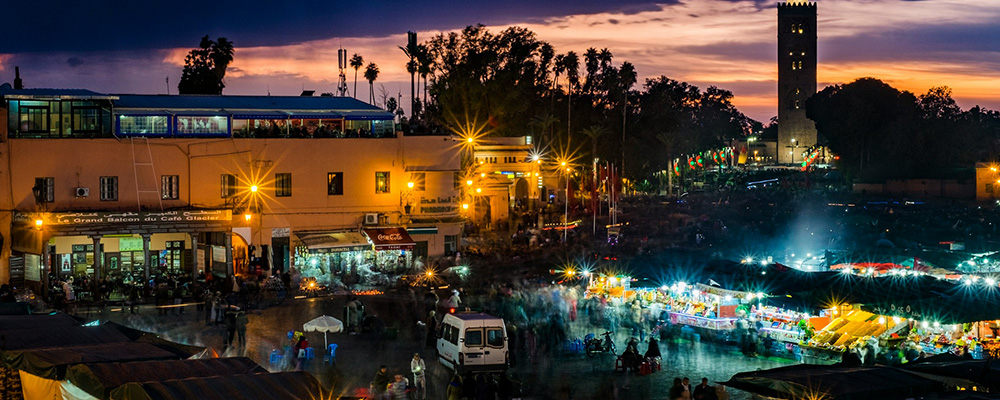
4. Jemaa el-Fna: The Meeting Point Between North and South
Whenever I explain the geography of Marrakech to someone visiting for the first time, I use Jemaa el-Fna as a central reference point.
From here, the main souks extend northward, while other streets lead southeast toward Riad Zitoun, the palaces and the Mellah.
To the southwest, the Koutoubia Mosque provides another recognizable landmark.
I would encourage you to spend a few minutes observing the different entrances and exits around the square. Rather than seeing Jemaa el-Fna only as a tourist attraction, think of it as a meeting point connecting several different worlds within the historic city.
Traders, residents, food vendors, artisans and visitors all contribute to its changing atmosphere throughout the day.
5. Rue Riad Zitoun El Kedim: From the Square Toward Southern Marrakech
Rue Riad Zitoun El Kedim, sometimes spelled Riad Zitoun Lakdim, is one of the important streets extending southward from the central Medina.
It offers a useful connection toward the area surrounding Place des Ferblantiers, El Badi Palace, the Mellah and the southern neighborhoods.
What I find interesting about this route is how the atmosphere gradually changes as we move away from Jemaa el-Fna.
The dense commercial environment of the central souks gives way to a mixture of riads, restaurants, neighborhood businesses and residential passages.
When walking here, I recommend paying attention to the smaller entrances branching away from the main street. Many lead toward traditional houses and guesthouses rather than major markets.
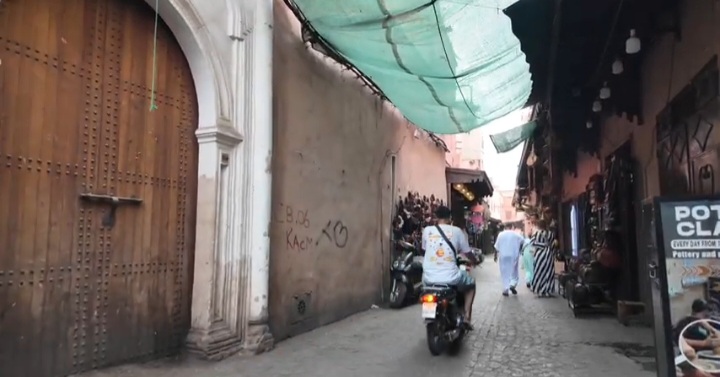
This is also an excellent opportunity to understand the difference between a main connecting street and a derb, which may serve only a small residential community.
6. Rue Riad Zitoun El Jdid: Connecting Jemaa el-Fna with Bahia Palace
Rue Riad Zitoun El Jdid provides another important route through the southeastern Medina.
It is particularly useful for visitors heading toward Bahia Palace and its surrounding neighborhoods.
Although Riad Zitoun El Kedim and Riad Zitoun El Jdid run through the same general part of Marrakech, they offer different walking experiences and access to different residential and commercial passages.
When we explore this area, I prefer not to rush directly toward the palace. There is much to appreciate along the way, including traditional buildings, wooden doors and the architectural details that distinguish the old city.
For visitors staying in riads in southern Marrakech, learning these two street names can make independent exploration considerably easier.
7. Place des Ferblantiers, the Mellah and the Kasbah
As we move farther south, Place des Ferblantiers becomes another useful orientation point.
From this area, visitors can explore the historical Jewish quarter known as the Mellah, approach El Badi Palace or continue toward the Kasbah through connecting streets.
I like to explain this part of Marrakech through its historical communities and institutions, not just its monuments.
The Mellah developed its own distinctive cultural and architectural identity, while the Kasbah reflects the importance of royal and administrative power in the history of Marrakech.
By walking between these neighborhoods, we can discover how different communities contributed to the development of the same historic city.
Continuing toward Bab Agnaou and the Kasbah Mosque brings us into another important part of southern Marrakech, with its own markets, residential streets and historical landmarks.
Which North-to-South Route Would I Recommend?
If you have never visited Marrakech before and want to understand how the Medina connects, I would suggest the following walking sequence:
- Ben Youssef Madrasa and the surrounding historic area.
- The central artisan streets.
- Souk Semmarine or the Mouassine connections.
- Jemaa el-Fna.
- Rue Riad Zitoun El Kedim or El Jdid.
- Place des Ferblantiers.
- The Mellah or El Badi Palace area.
- The Kasbah and Bab Agnaou.
This route is not intended to be a race between attractions. We can adapt it according to your interests, whether you enjoy architecture, photography, history, traditional crafts or simply observing local life.
Walking Distances Between Northern and Southern Marrakech
| Walking section | Approximate distance | Walking time |
|---|---|---|
| Ben Youssef to Jemaa el-Fna | 800 m–1 km | 12–18 minutes |
| Dar El Bacha to Jemaa el-Fna | 1–1.3 km | 15–22 minutes |
| Jemaa el-Fna to Bahia Palace | 900 m–1.2 km | 15–20 minutes |
| Jemaa el-Fna to El Badi Palace | 1–1.3 km | 15–22 minutes |
| Ben Youssef to the Kasbah | 2–2.7 km | 35–50 minutes |
These are approximate planning estimates rather than fixed measured routes. Your actual distance depends on the streets, connecting passages and detours you choose.
For a meaningful guided exploration, I would allow approximately three to four hours, especially if we stop to discuss architecture, visit workshops or enter historical monuments.
Map of the Northern and Southern Medina Connections
You can use this Google Maps walking route from Ben Youssef to Bab Agnaou to visualize the general connection between the northern and southern Medina.
I recommend using the map as a reference rather than following every suggested turn without question. Some narrow passages may be private, temporarily obstructed or difficult to recognize.
Learning to Recognize the Streets Like a Local
One of the things I enjoy explaining about Marrakech is that residents do not necessarily navigate the Medina in the same way as visitors.
A visitor may remember a restaurant name or a location saved on a telephone. Residents may recognize a neighborhood through its mosque, fountain, bakery, market or an old family name.
Here are a few useful expressions you can use when speaking with people along the way:
- Fin kayna Jemaa el-Fna? Where is Jemaa el-Fna?
- Fin kayn Bab Agnaou? Where is Bab Agnaou?
- Shukran. Thank you.
- La, shukran. No, thank you.
We speak Moroccan Arabic in our everyday lives, and even a few simple words can make an interaction feel more personal.
Of course, residential passages are not necessarily public attractions. We always encourage visitors to respect people's privacy and ask permission before photographing residents or artisans.
Why I Prefer Walking Across the Medina Rather Than Around It
For me, the beauty of Marrakech is not confined to a famous palace, an impressive mosque or a colorful market.
It is also found in the connections between these places.
We can leave the historic surroundings of Ben Youssef, pass through streets associated with traditional commerce, cross Jemaa el-Fna and eventually arrive in neighborhoods shaped by royal history and Jewish heritage.
Within a single walk, the architecture changes, the commercial activities change and the atmosphere changes.
That is what makes Marrakech such an interesting city to discover on foot.
Frequently Asked Questions
Can you walk from northern to southern Marrakech Medina?
Yes. The historical neighborhoods are connected through a network of pedestrian-friendly streets. Ben Youssef, the central souks, Jemaa el-Fna, the Mellah and the Kasbah can all form part of the same walking itinerary.
Which street connects the northern souks with Jemaa el-Fna?
Souk Semmarine is one of the principal commercial connections. Mouassine and the streets around Rue Biadine offer alternative approaches through the central Medina.
Which streets lead from Jemaa el-Fna toward the southern Medina?
Rue Riad Zitoun El Kedim and Rue Riad Zitoun El Jdid are two of the most useful streets for reaching the southeastern neighborhoods, palace district and areas surrounding the Mellah.
Can we avoid the busiest souks when walking across Marrakech?
Yes. We can adapt the route to include less crowded connecting streets and residential neighborhoods, although conditions vary throughout the day.
Is this walk suitable for photographers?
Yes. The changing architecture, covered markets, traditional doors and everyday street scenes offer many photographic opportunities. Always ask permission before photographing people.
Do I need a guide to explore these streets?
No, you can explore independently. However, a local guide can help you understand historical connections, recognize important landmarks and discover details that are easily overlooked when walking alone.
Discover Marrakech With Us
At Visit Marrakech Medina, our approach is to help you understand the historic city through its people, streets, craftsmanship and cultural heritage.
Our guiding experience and the history of our work are described on our website, including our references to Daniel Jacobs and The Rough Guide to Morocco and Rick Steves.
For additional travel reading, you can explore Rough Guides' Marrakech travel information and Rick Steves' travel resources.
Whether you are interested in historical neighborhoods, hidden streets, traditional markets or Moroccan craftsmanship, we can organize a walk around your personal interests.
Explore our private Marrakech Medina walking tour, our authentic Marrakech souks shopping tour or our specialized Moroccan rug shopping tour.
Tell us what you would like to discover. We will be happy to help you explore Marrakech through the streets and neighborhoods that make our city so special.
Contact us directly: WhatsApp +212 614 905 398 or complete our online booking and contact form.
Written from the local guiding perspective of Visit Marrakech Medina, sharing the historic city with travelers since 2004.