
Dar el-Bacha Bab Doukkala History Streets
What are the historic streets connecting Dar el-Bacha and Bab Doukkala in Marrakech?
The historic streets connecting Dar el-Bacha and Bab Doukkala form one of the most fascinating walking routes in the northwestern Marrakech Medina. This area connects former palaces, traditional riads, historic caravanserais, neighbourhood markets, religious buildings and residential alleyways. It is an excellent place to discover the authentic organisation of the old city, whether through our Marrakech Medina Guide, our private Medina walking tour, our Marrakech souks shopping tour or our Moroccan carpets and rug shopping tour.
Visit Marrakech Medina is a local walking and shopping tour company specialising in the historic Medina, its traditional neighbourhoods, craftsmanship and cultural heritage. We have been guiding travellers through Marrakech since 2004. Our Medina walking tour was featured by Daniel Jacobs in The Rough Guide to Morocco. Our guiding services have also been discussed and recommended on the Rick Steves travel forum.

Where are Dar el-Bacha and Bab Doukkala located?
Dar el-Bacha and Bab Doukkala are situated in the northwestern part of Marrakech Medina, west of the central souks and northwest of Jemaa el-Fna.
Dar el-Bacha stands between the historic Mouassine district and the residential streets leading towards Bab Doukkala. Bab Doukkala itself is one of the historic gateways through the defensive walls of Marrakech.
The streets connecting these two landmarks reveal the transition between the commercial heart of the Medina and neighbourhoods historically organised around residential life, religious institutions and local services.
Dar el-Bacha: The former residence of the Pasha of Marrakech
Dar el-Bacha, meaning the House of the Pasha, is associated with Thami El Glaoui, the influential Pasha of Marrakech during the first half of the twentieth century.
Built in the early twentieth century, the palace reflects the refined architectural traditions of wealthy Moroccan residences. Its interior brings together several important elements of Moroccan craftsmanship:
- Hand-cut zellige geometric tilework.
- Intricately carved plaster.
- Decorated cedarwood ceilings and doors.
- Central courtyards and fountains.
- Traditional Moroccan gardens.
- Ornamental archways and symmetrical architectural compositions.
Today, the palace houses the Museum of Confluences, presenting aspects of Moroccan cultural heritage and artistic traditions.
However, the historical importance of Dar el-Bacha extends beyond the palace itself. The surrounding streets, former merchant buildings and residential houses help explain the relationship between political authority, urban commerce and everyday life in Marrakech.
Rue Dar el-Bacha and its historic commercial connections
Rue Dar el-Bacha is an important passage between the Mouassine neighbourhood, the central souks and the western Medina.
Near its junction with Rue Mouassine, historic fondouks provide evidence of the area's former commercial activities.
A fondouk was traditionally a building where travelling merchants could lodge, store merchandise and accommodate their transport animals. These establishments generally featured rooms and working spaces arranged around an interior courtyard.
Some former fondouks have been adapted into artisan workshops, commercial premises or other uses, preserving elements of their original architecture.
When walking through this area, look beyond the shopfronts. Large wooden entrances, internal courtyards and upper-floor galleries can reveal a building's former function.
Rue Arset Aouzane: A connection between palace and neighbourhood life
Rue Arset Aouzane forms part of the historic network of streets connecting Dar el-Bacha with the Bab Doukkala mosque area.
The name Arset refers to a garden or cultivated enclosure, reflecting the historical importance of gardens and planted spaces within the urban landscape of Marrakech.
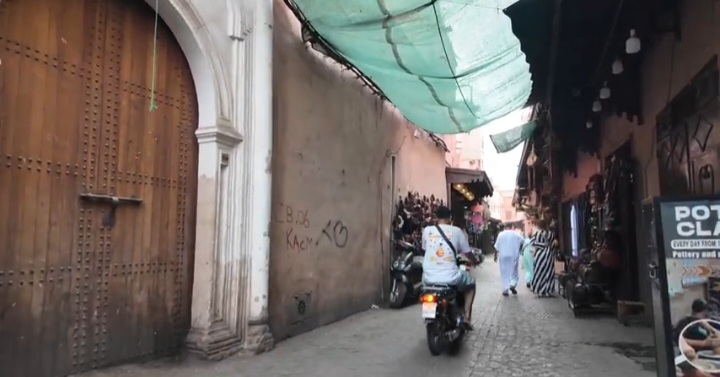
Along this route, visitors encounter traditional residential buildings, riads, small businesses and passages leading into quieter derbs.
Unlike the specialised commercial streets of the central souks, these streets combine several different functions. They are places where residents live, shop, work and move between neighbourhood services.
This mixture of activities is one of the characteristics that distinguishes the historic Medina from a conventional tourist shopping district.
The historic fondouks between Dar el-Bacha and Bab Doukkala
The official Marrakech heritage route identifies several traditional fondouks along the wider passage connecting the Bab Doukkala and Dar el-Bacha areas, including the Tadlaoui, Alamri, Almizane and Kharbouche fondouks.
These buildings illustrate the historical importance of commerce and craftsmanship within the western Medina.
Their architectural organisation reveals how traditional commercial buildings were designed to accommodate goods, merchants and working activities while remaining connected to the narrow streets of the city.
Not every fondouk is open to visitors. Some remain private or function as working environments. Always ask permission before entering or photographing artisans.
Derb Zemrane and the traditional riads of Marrakech
Smaller residential passages branch off the main streets connecting Dar el-Bacha and Bab Doukkala. Among them is Derb Zemrane, associated with the historic residence of the French scholar and translator Denise Masson.
These residential derbs reveal an important principle of traditional Moroccan urban architecture: the contrast between modest exterior walls and richly organised interior spaces.
From the street, a traditional house may appear relatively simple. Behind its entrance, however, there may be a courtyard, a garden, a fountain and rooms arranged around an open central space.
This inward-looking architectural organisation provides privacy, shade and separation from the activity of the surrounding streets.
Bab Doukkala Mosque and its Saadian heritage
The Bab Doukkala Mosque is one of the significant religious monuments of the western Medina. Dating from the sixteenth-century Saadian period, it is associated with Lalla Masuda, the mother of Sultan Ahmad al-Mansur.
The mosque formed part of a wider religious and social complex that included facilities serving the surrounding population.
Traditional neighbourhood institutions included public fountains, hammams, places of religious education and other services connected to everyday community life.
The Bab Doukkala Mosque remains an active place of worship. Non-Muslim visitors can appreciate its exterior architecture and the surrounding neighbourhood without entering the prayer areas.
The historic Bab Doukkala fountain
Near the mosque stands the Bab Doukkala fountain, an important example of the traditional relationship between water distribution, religious architecture and public services in Marrakech.
Before modern domestic water networks became widespread, public fountains played an essential role in supplying neighbourhood residents with water.
Their architectural decoration also reflected the importance given to public infrastructure in traditional Moroccan cities.
The Bab Doukkala fountain belongs to a wider network of historic fountains connecting different parts of the Medina, including Sidi Abdelaziz and Riad Laarous.
This heritage can also be explored through the official Marrakech historic water route.
Bab Doukkala Gate: An entrance to medieval Marrakech
Bab Doukkala is one of the historic gates of Marrakech, with origins in the Almoravid period, when the city's defensive walls were established during the twelfth century.
The gate takes its name from the Doukkala region of Morocco, historically associated with routes extending northwest of Marrakech.
Like other gates of the Medina, Bab Doukkala served several purposes:
- Controlling access to the fortified city.
- Connecting Marrakech with surrounding regions.
- Facilitating the movement of merchants and agricultural goods.
- Providing a geographical reference for surrounding neighbourhoods.
- Linking the historic city with external transport routes.
Today, the area remains an important connection between the historic Medina and the modern city.
What can you discover in the Bab Doukkala neighbourhood markets?
The commercial streets surrounding Bab Doukkala retain a strong connection with the everyday needs of Marrakech residents.
Depending on the street and the time of day, visitors may encounter vegetable sellers, fruit stalls, bakeries, spice merchants, butchers, small grocery shops and traditional food businesses.
Unlike markets specialising primarily in decorative crafts and souvenirs, these neighbourhood shops reveal the practical commercial organisation of the Medina.
Morning is a particularly interesting time to observe deliveries, residents purchasing fresh ingredients and local businesses preparing for the day.
Walking route from Dar el-Bacha to Bab Doukkala
This short walking route can be explored independently or incorporated into a longer discovery of the western Marrakech Medina.
- Begin at the entrance of Dar el-Bacha Museum.
- Follow the historic streets towards Rue Arset Aouzane.
- Observe the traditional riads and residential derbs.
- Continue towards the Bab Doukkala Mosque and its historic fountain.
- Explore the surrounding neighbourhood shops and food markets.
- Finish at the historic Bab Doukkala Gate and city ramparts.
Approximate walking distances
| Walking route | Approximate distance | Walking time |
|---|---|---|
| Dar el-Bacha to Bab Doukkala Mosque | 400–600 metres | 5–9 minutes |
| Dar el-Bacha to Bab Doukkala Gate | 800 metres–1 kilometre | 10–15 minutes |
| Dar el-Bacha to Le Jardin Secret | 400–600 metres | 5–9 minutes |
| Bab Doukkala Gate to Jemaa el-Fna | 1.3–1.7 kilometres | 18–25 minutes |
These distances are approximate planning estimates and may vary depending on the passages selected, pedestrian traffic and temporary street restrictions.
View the walking route from Dar el-Bacha to Bab Doukkala on Google Maps.
Allow approximately 45 to 90 minutes if you want to observe the architecture, explore the surrounding markets and stop for photographs. Museum visits require additional time.
How do these streets connect with Mouassine and the central souks?
Dar el-Bacha provides a natural connection between the western residential neighbourhoods and the commercial streets around Mouassine.
From Mouassine, visitors can continue towards Le Jardin Secret, the traditional fountain, the dyers' quarter and the central souks.
This geographical relationship demonstrates how the Medina is organised as an interconnected network rather than a collection of isolated attractions.
For a deeper understanding of the commercial and residential passages of the old city, explore the Secret Loop of Marrakech Medina.
What makes this part of Marrakech Medina different?
The streets between Dar el-Bacha and Bab Doukkala bring together several layers of Marrakech history within a relatively small geographical area.
- Almoravid defensive architecture represented by the historic city gate.
- Saadian religious and public architecture represented by the mosque and fountain.
- Traditional commercial architecture represented by the fondouks.
- Early twentieth-century palatial architecture represented by Dar el-Bacha.
- Residential architecture represented by riads and narrow derbs.
- Contemporary neighbourhood life represented by local markets and businesses.
For visitors interested in urban history, this combination helps explain how Marrakech developed over centuries while preserving many characteristics of its traditional organisation.
Practical advice for exploring Dar el-Bacha and Bab Doukkala
- Explore in the morning when temperatures are generally cooler and neighbourhood businesses are active.
- Wear comfortable walking shoes suitable for uneven surfaces.
- Ask permission before photographing residents, artisans or people working in the markets.
- Respect private residential passages and religious buildings.
- Be aware of motorcycles, bicycles and delivery carts sharing the streets.
- Use the mosque, palace and historic gate as your main geographical reference points.
For additional information about the architectural heritage and historic districts of the city, consult the Rough Guides Marrakech travel guide.
Frequently asked questions
Can you walk from Dar el-Bacha to Bab Doukkala?
Yes. The two landmarks are connected by historic streets in the northwestern Medina. The direct walk generally takes around 10 to 15 minutes, depending on your route.
Is Bab Doukkala a traditional residential neighbourhood?
Yes. The wider Bab Doukkala neighbourhood combines residential houses, traditional riads, local markets, religious buildings and everyday commercial activities.
Are there historic caravanserais near Dar el-Bacha?
Yes. Several traditional fondouks survive in the area around Rue Dar el-Bacha and the adjoining historic streets. Some have been adapted for commercial and artisanal activities.
Is Bab Doukkala Gate older than Dar el-Bacha Palace?
Yes. Bab Doukkala Gate has medieval Almoravid origins, while Dar el-Bacha Palace dates from the early twentieth century.
Can you visit the Bab Doukkala Mosque?
Non-Muslim visitors can view the exterior of the mosque, its surrounding streets and the historic fountain. The interior prayer areas are reserved for Muslims.
Is this area suitable for photography?
Yes. Traditional doorways, historic buildings, architectural details and neighbourhood streets provide interesting photographic opportunities. Always respect residents' privacy and ask permission before photographing people.
Do you need a local guide to explore these streets?
A guide is not essential for following the main route. However, an experienced local guide can explain the historical functions of buildings, the origins of neighbourhood names and the architectural details that are easily overlooked.
Discover the historic streets of Marrakech with a local guide
Exploring the streets between Dar el-Bacha and Bab Doukkala is an opportunity to understand Marrakech beyond its famous monuments and busy tourist markets.
Our private guided experiences can combine historic neighbourhoods, traditional architecture, former caravanserais, artisan workshops and the everyday life of the Medina according to your interests.
For personalised walking experiences, local recommendations or questions about exploring Marrakech, contact us directly on WhatsApp.
About the authors
This article was prepared for Visit Marrakech Medina, an independent local walking and shopping tour company with guiding experience in Marrakech since 2004. Our specialisation includes the historic geography of the Medina, traditional souks, Moroccan craftsmanship, residential neighbourhoods, cultural heritage and authentic local experiences.
Discover more about Marrakech and our guided experiences on the Visit Marrakech Medina homepage.