
Walking Through Time: Marrakesh History Revealed
.jpeg)
Walking Through Time: Marrakesh’s History Revealed Step by Step
From the moment you set foot in Marrakesh, you can feel it—the pulse of time beating beneath the red dust of the old streets, the whispers of merchants echoing through the souks, and the scent of history woven into every corner of the Medina. Marrakesh is not just a city; it is a living museum of centuries, a place where the past and present walk side by side. To truly understand its story, you must explore it on foot—step by step, through the layers of time that shaped it into the dazzling heart of Morocco.
Visit our dedicated Marrakesh walking tour page
The Birth of Marrakesh: From Desert to Dynasty
Long before it became one of the most enchanting cities in the world, Marrakesh began as a humble desert outpost. Founded in 1070 by Abu Bakr ibn Umar, a leader of the Almoravid dynasty, it quickly evolved into a powerful imperial capital. The Almoravids, known for their architectural skill and religious devotion, built walls, mosques, and palaces that laid the foundation of the city we see today. As you walk through the Medina, the reddish clay walls that still encircle the city stand as a testament to that early period of construction and vision. The choice of red sandstone gave Marrakesh its famous nickname—the “Red City.” Every sunrise brings that color to life, illuminating the streets and rooftops in a warm glow that feels eternal.
The Rise of the Almoravids: Faith and Power
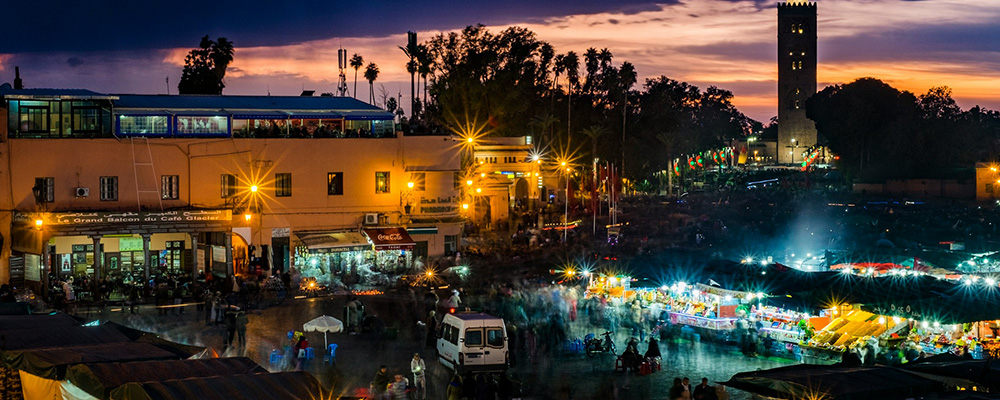
The Almoravids did more than establish a capital; they created a center of Islamic scholarship and trade. The Koutoubia Mosque, the spiritual heart of Marrakesh, has its origins in that period. Its towering minaret dominates the skyline, a symbol of unity and devotion. Walking along the mosque’s gardens, you can almost hear the murmur of scholars reciting the Qur’an, the sounds of camels arriving with goods from sub-Saharan Africa, and the laughter of children playing near the city gates. This was Marrakesh’s golden beginning—a fusion of faith, architecture, and ambition.
The Almohads and the Expansion of Splendor
After the Almoravids came the Almohads, another Berber dynasty, who took control in the 12th century and left an even deeper mark. They expanded the city, rebuilt the Koutoubia Mosque, and strengthened Marrakesh’s reputation as a beacon of art, philosophy, and architecture. The Almohads were perfectionists—they introduced symmetry and grandeur that inspired future dynasties. If you walk from the Koutoubia to the Kasbah area, you’ll see traces of their work everywhere: grand gates like Bab Agnaou, elegant gardens, and carefully aligned streets that reflect their disciplined vision. Marrakesh under the Almohads became a true imperial city, echoing with poetry, science, and political might.
Marrakesh and the Saadian Renaissance
Centuries later, the Saadian dynasty brought Marrakesh into a new age of beauty and prosperity. Their reign from the 16th to the 17th century transformed the city into a jewel of the Maghreb. The Saadian Tombs, hidden for centuries before being rediscovered in 1917, remain one of the city’s most exquisite sites. When you step inside, the silence feels sacred. The ceilings are decorated with cedar, stucco, and gold leaf—each detail reflecting the refined artistry of their era. The Saadians also constructed palaces, mosques, and gardens that still define Marrakesh’s identity today. The El Badi Palace, once called “The Incomparable,” was a masterpiece of Moroccan craftsmanship, featuring marble from Italy, gold from Sudan, and tiles from Andalusia. Though now in ruins, its grandeur is still palpable; walking through its vast courtyards, one can almost imagine the music, feasts, and royal ceremonies that once took place there.
The Medina: Marrakesh’s Living Heart
To walk through Marrakesh’s Medina is to travel through time itself. Every alley, every door, and every market stall tells a story. The Medina, now a UNESCO World Heritage Site, is a labyrinth of human connection—traders, artisans, and families living and working in the same rhythm that has endured for nearly a thousand years. Begin your walk at Jemaa el-Fna, the legendary square where magic unfolds daily. In the morning, it’s filled with juice vendors and storytellers; by afternoon, it’s alive with musicians, henna artists, and snake charmers; and by night, it transforms into a sea of food stalls, smoke, and laughter. From Jemaa el-Fna, wander into the souks. Each section has its own identity: the spice souk dazzles with colors and scents, the leather souk hums with the sounds of craftsmen at work, and the jewelry souk sparkles with gold and silver. Walking through them is like reading the chapters of a living book.
Hidden Corners and Forgotten Alleys
Beyond the famous souks lies another Marrakesh—quieter, older, and deeply spiritual. In neighborhoods like Ben Youssef, you’ll find the Medersa Ben Youssef, once the largest Islamic school in North Africa. Its delicate carvings and geometric patterns reflect centuries of devotion to learning and faith. When you step inside, the noise of the city disappears, replaced by the calm echo of footsteps on ancient tiles. Around this area, small artisan workshops still thrive: woodcarvers, metalworkers, and weavers continue their ancestral crafts using techniques passed down through generations. This is the Marrakesh that most tourists never see—the one where tradition breathes naturally, untouched by time.
The French Protectorate and the Modern Era
In the early 20th century, Morocco came under the French Protectorate, and Marrakesh experienced another transformation. The colonial administration built the “new city,” known as Gueliz, introducing European architecture, wide boulevards, and cafes that blended Moroccan charm with French elegance. While the Medina preserved its ancient rhythm, Gueliz became the modern counterpart—a space for art galleries, boutiques, and government offices. The contrast between old and new Marrakesh became part of its magic: a city that lives in two worlds at once, where the past is never forgotten, and the future always beckons.
The Gardens of Eternity
Walking through Marrakesh’s gardens offers a different kind of journey through time. The Menara Gardens, dating back to the Almohad dynasty, still serve as a peaceful retreat for locals. Its vast basin, reflecting the Atlas Mountains, was once used for irrigation but now stands as a symbol of tranquility. The Majorelle Garden, on the other hand, is a 20th-century masterpiece created by French painter Jacques Majorelle and later restored by fashion designer Yves Saint Laurent. With its vivid blue walls and exotic plants, it represents the artistic evolution of Marrakesh—a bridge between Moroccan tradition and global creativity. Each garden tells a part of the story, reminding visitors that beauty and balance are timeless.
Cultural Legacy and Living Traditions
Marrakesh is not merely a city of monuments; it is a city of living traditions. As you walk through it, you’ll encounter the guardians of its culture—the artisans, storytellers, and musicians who keep the spirit of the past alive. The Gnawa musicians, for instance, play ancient rhythms that trace their roots to sub-Saharan Africa. Their hypnotic performances in Jemaa el-Fna are not just entertainment; they are acts of preservation, connecting today’s visitors to centuries of migration, faith, and freedom. The tanners of the leather souk, though working in harsh conditions, still follow medieval techniques to dye leather using natural colors. Every product they make is a piece of history shaped by human hands.
The Architecture of Time
Walking through Marrakesh’s streets, one is struck by the city’s architectural dialogue between past and present. From the red ramparts and minarets to riads and hammams, Marrakesh’s architecture embodies Moroccan identity. The riads—traditional houses with interior courtyards—were designed for privacy and family life, shielding inhabitants from heat and noise while creating an oasis of calm inside. Today, many riads have been restored into guesthouses, allowing travelers to live within centuries-old walls and experience the authentic heartbeat of the city. Each riad tells a story through its zellij (mosaic tiles), carved wood, and fountains. Marrakesh’s mosques, gates, and gardens follow the same pattern: harmony, symmetry, and an enduring sense of balance.
Spiritual Marrakesh: Sufi Saints and Sacred Places
Marrakesh has always been a spiritual center, home to many Sufi saints and scholars. The Mausoleum of Sidi Bel Abbès, one of the seven saints of Marrakesh, is a pilgrimage site for Moroccans seeking blessings and healing. Every year, festivals dedicated to these saints bring the community together in prayer and celebration. The city’s spirituality is not confined to mosques—it lives in the call to prayer echoing over rooftops, in the hospitality offered to strangers, and in the peaceful coexistence of tradition and modernity.
Walking Tours: The Best Way to Discover Marrakesh’s Story
To truly experience Marrakesh’s layers of history, walking is essential. A guided walking tour allows you to see what most travelers miss: the small details, the stories behind the doors, and the human connections that define the city. As you walk with a local guide, the past unfolds before your eyes—each street revealing a new era, each artisan telling a tale passed down for centuries. Walking tours not only connect you to Marrakesh’s history but also support local communities, ensuring that the traditions of the Medina continue to thrive. When you explore on foot, you are not just a visitor; you become part of Marrakesh’s living story.
The Eternal Spirit of the Red City
Marrakesh is more than a destination—it is an emotion, a memory, and a living soul. Every stone, every fragrance, every melody speaks of resilience and renewal. The city has endured wars, dynasties, and revolutions, yet it continues to shine as Morocco’s beating heart. To walk through Marrakesh is to walk through time itself—to witness history not behind glass or in books, but alive, breathing, and ever-changing. From its ancient walls to its vibrant markets, Marrakesh invites every traveler to slow down, listen, and feel the rhythm of centuries beneath their feet.
Conclusion: Step by Step Through Time
When you finish your journey through Marrakesh, you realize that the city has not only revealed its history—it has shared its soul. The sounds of Jemaa el-Fna, the quiet courtyards of the riads, the scent of spices, and the call to prayer all blend into one unforgettable memory. Marrakesh’s magic lies in its ability to make time disappear; whether you are standing before the ruins of El Badi Palace or sipping mint tea on a rooftop terrace, you feel connected to something eternal. So walk slowly, breathe deeply, and let Marrakesh reveal itself to you—step by step, through time.
WhatsApp Morocco +212614905398