
Bahia Palace Marrakech Guide
Why Is Bahia Palace One of the Most Beautiful Places to Visit in Marrakech?
Bahia Palace is one of the most remarkable historic monuments in Marrakech. Located in the southern part of the old Medina, it is known for its spacious courtyards, peaceful gardens, carved plaster, colourful zellige tilework and beautifully decorated cedar ceilings. Built and expanded during the second half of the 19th century, the palace offers an exceptional introduction to the architecture and craftsmanship of Morocco.
If you are planning to explore the old city, you can also discover the surrounding streets and traditional neighbourhoods on a guided Marrakech Medina walking tour. For travellers who prefer to explore with a small group, see our Marrakech group tours. Before setting out, our local guide to Marrakech souk opening and closing times can also help you organise the rest of your day.
I have been guiding visitors through Marrakech since 2004. Over the years, I have learned that a monument becomes much more interesting when you understand the people who built it, the artisans behind its decoration and the life of the Medina around it. My guiding work has also been recognised in travel-guide coverage, including Rough Guide, and in a recommendation shared on the Rick Steves Travel Forum. This guide brings together the historical background and practical knowledge visitors need before exploring Bahia Palace.
Where Is Bahia Palace in Marrakech?
Bahia Palace stands in the southern part of Marrakech's historic Medina, in the Riad Zitoun area, close to the old Mellah, the former Jewish quarter. Its location makes it convenient to combine a visit with other historic places in this part of the city.
From Jemaa el-Fna, visitors can walk towards the southern Medina through the streets leading to Riad Zitoun. The route takes you away from the busiest part of the square and into a neighbourhood where historic residences, small shops and traditional streets form part of everyday Medina life.
The palace entrance is on Rue Riad Zitoun el-Jdid. If you are arriving by taxi, ask to be dropped near the accessible approach to the palace rather than expecting a taxi to take you directly through the narrow Medina streets.
Bahia Palace Opening Hours and Ticket Prices
Bahia Palace is a ticketed historic monument managed by Morocco's Ministry of Youth, Culture and Communication. The official ticket portal currently publishes the following visitor information.
Opening hours: Daily from 9:00 am to 5:00 pm.
Foreign adult ticket: 100 MAD.
Foreign child aged 7 to 13: 50 MAD.
Moroccan or resident adult: 30 MAD.
Moroccan or resident child aged 7 to 13: 10 MAD.
The official portal also states that free entry is granted to people with reduced mobility and to Moroccan nationals on Fridays and on the first day of national and religious holidays. These conditions are subject to the official rules in force.
Check the official Bahia Palace ticket page before your visit. Opening arrangements, prices and access conditions can change, so the Ministry's information should take priority over older travel articles.
How Much Time Should You Spend at Bahia Palace?
For most visitors, around one hour is a reasonable starting point. You may need longer if you enjoy architecture, photography or taking time to examine the decoration in the different rooms and courtyards.
It is worth avoiding a rushed visit. Many people enter, photograph the large marble courtyard and leave without paying much attention to the smaller spaces. Yet the character of Bahia Palace is found in the contrast between its large open court, quieter garden areas and richly decorated interiors.
The History of Bahia Palace
The history of Bahia Palace is closely connected to two powerful figures in 19th-century Morocco: Si Moussa and his son, Ba Ahmed. The palace was not constructed in one single campaign. It developed in stages, with an earlier residence later expanded into a much larger complex.
Si Moussa and the Earlier Residence
The first major phase is associated with Si Moussa, who held important positions in the Moroccan royal administration. According to the Ministry of Culture, his residence included the large riad, a northern courtyard and several annexes. The renovation of this earlier residence was completed around 1866–1867.
This earlier section is important because it helps explain why the palace does not follow the layout of a single building designed all at once. It is a collection of connected spaces that developed over time.
Ba Ahmed and the Expansion of the Palace
From 1894, Ba Ahmed, the son of Si Moussa, expanded the residence. He acquired neighbouring houses and incorporated them into a much larger complex. The Ministry of Culture records this major construction phase as lasting from 1894 to 1900.
Ba Ahmed was a powerful Grand Vizier during the reign of Sultan Moulay Abdelaziz. The palace reflected the position, wealth and influence of the household. Its rooms, gardens and courtyards were arranged to provide different settings for private life, reception and administration.
After Ba Ahmed's death in 1900, the palace entered another chapter in its history. In 1912, it underwent further changes when it became the residence of the French Resident General in Marrakech.
What to See Inside Bahia Palace
Bahia Palace is not simply one large courtyard surrounded by decorated rooms. It is a sequence of different spaces, each with its own proportions, atmosphere and architectural details. The Ministry describes four main courtyards, alongside gardens, salons and annexes.
The Grand Courtyard
The Grand Courtyard is the most recognisable part of Bahia Palace. Its broad open space, marble paving and surrounding galleries create a striking contrast with the smaller passages and enclosed rooms that lead towards it.
Take a moment to look beyond the centre of the courtyard. Notice how the galleries frame the space, how the decorated surfaces change as you move around it and how the architecture creates different views from different corners.
The courtyard is particularly impressive because of its scale. It gives visitors a sense of the importance attached to reception and display within the palace. The open space also allows light to reach the surrounding galleries and makes the colours of the decoration more visible.
The Grand Riad and Its Garden
The Grand Riad belongs to the earlier phase of the palace associated with Si Moussa. Unlike the broad paved courtyard, this area has a more enclosed and garden-like atmosphere.
Traditional Moroccan riads are organised around an interior space, often with a garden or courtyard at the centre. This arrangement creates privacy and brings light, greenery and a sense of calm into the residence.
At Bahia Palace, the Grand Riad offers a different experience from the monumental courtyard. Look at the relationship between the planted area, the surrounding rooms and the decorated architectural details.
The Smaller Riad and Interior Rooms
The smaller riad and its adjoining rooms form part of the later development of the palace. These spaces are more intimate than the Grand Courtyard and reveal another side of the residence.
Look carefully at the doorways, arches, painted wood and plasterwork. The decoration is not limited to one large feature. It continues around entrances, ceilings and wall surfaces, creating a complete decorative environment.
The Reception Rooms
Reception rooms were important in a residence belonging to a powerful household. Their decoration communicated status and demonstrated the skills of the artisans who worked on the building.
When you enter a decorated room, look up at the ceiling, then examine the doors and the areas around the arches. The details are easy to miss if you concentrate only on taking a photograph from the doorway.
Understanding the Moroccan Craftsmanship at Bahia Palace
One of the most rewarding parts of visiting Bahia Palace is discovering the variety of traditional Moroccan crafts used in its decoration. The palace brings together several techniques that visitors can also encounter in the workshops and souks of Marrakech.
Zellige – Moroccan Geometric Tilework
Zellige is a traditional Moroccan form of mosaic made from small pieces of glazed terracotta tile. Artisans cut and shape the pieces before arranging them into geometric compositions.
Rather than seeing the finished surface as one printed pattern, look closely at the individual pieces. The geometry depends on the careful cutting, positioning and fitting of many small elements. The result is a surface that combines colour, repetition and mathematical precision.
Visitors interested in this craft can discover more about traditional handmade goods during a Marrakech souks shopping experience, where the city's craft traditions can be explored beyond the palace walls.
Carved Plaster and Stucco
Carved plaster is another important feature of Moroccan architecture. At Bahia Palace, it appears around arches, doorways and other architectural details.
Look at the depth of the patterns and the way the decoration follows the shape of the architecture. The work requires patience and precision, particularly when several layers of geometric or floral motifs are combined.
Painted Cedar Wood
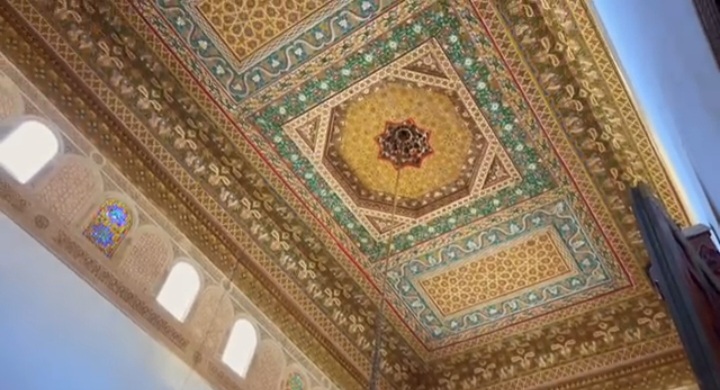
Painted cedar is especially noticeable on ceilings and wooden architectural elements. The decoration may include floral patterns, geometric forms and carefully arranged colours.
Do not look at every ceiling as though it were identical. Take time to notice differences in the patterns, colours and composition from one room to another. These details help make the palace feel like a collection of individual spaces rather than a single decorated building.
Marble, Woodwork and Coloured Glass
The Ministry's description of Bahia Palace also identifies marble, moucharabieh, stained glass, wood carving and painting among its decorative features.
These materials work together. Marble provides a smooth and durable surface, carved wood creates texture, coloured glass changes the quality of light, and zellige and plaster add colour and pattern. The overall effect comes from the combination of different crafts rather than from one material alone.
Why Bahia Palace Is More Than a Beautiful Monument
Bahia Palace is valuable not only because of its decoration but also because it reveals how an important household was organised during the 19th century. Its courtyards, private spaces, reception rooms and gardens show how architecture could respond to different needs within one residence.
It also offers an opportunity to understand the relationship between architecture and the craft traditions of Morocco. The palace is a permanent record of the skills used by artisans working with wood, plaster, tile, marble and glass.
For visitors who are discovering Marrakech for the first time, this makes Bahia Palace a useful introduction to the city's architectural heritage. It also provides context for the crafts and traditional trades that remain part of the Medina today.
When Is the Best Time to Visit Bahia Palace?
If you prefer a quieter experience, arriving close to the published opening time can be a sensible choice. The palace is a popular attraction, and the main courtyard can become busy when several groups arrive at the same time.
Morning visits can also be more comfortable during warmer periods of the year. However, the actual level of visitors and the light inside the different courtyards depend on the day and season.
Rather than rushing through the palace to avoid other visitors, allow enough time to appreciate the smaller spaces as well as the main courtyard.
What Can You Visit Near Bahia Palace?
One advantage of Bahia Palace is its location in the southern Medina. Several important historic places and traditional neighbourhoods are within the wider area, making it possible to continue exploring on foot.
The Mellah – Marrakech's Historic Jewish Quarter
The Mellah is the historic Jewish quarter of Marrakech. Its streets, market areas and historic buildings offer a different perspective on the history of the old city.
Walking through the area after visiting Bahia Palace helps place the monument within the wider history of the southern Medina. It is also an opportunity to see a neighbourhood with its own character, rather than moving directly from one major attraction to another.
El Badi Palace
El Badi Palace is another important historic monument in the southern part of the Medina. Its atmosphere is very different from Bahia Palace. While Bahia is known for its decorated interiors and courtyards, El Badi is recognised for its monumental scale and the remains of a once-grand palace complex.
Visiting both places gives travellers a useful comparison between two different periods of Marrakech's history.
Place des Ferblantiers
Place des Ferblantiers is a lively square in this part of the old city, associated with traditional metalwork and small shops. It is a convenient place to continue exploring the neighbourhood and observe another side of Medina life.
The Souks and Artisan Workshops
From the southern Medina, visitors can continue towards the central souks and discover the traditional commercial streets of Marrakech. These areas are known for crafts such as metalwork, leather, textiles, pottery, lamps and carpets.
If you would like to understand how these products are made and how to recognise different types of Moroccan craftsmanship, a dedicated shopping tour in Marrakech offers a more focused way to explore the artisan side of the city.
Should You Visit Bahia Palace Independently or With a Local Guide?
You can visit Bahia Palace independently. Its courtyards and decorated rooms are impressive even without a guide, and visitors who enjoy architecture and photography may prefer to explore at their own pace.
However, understanding the history behind the building can make the visit more meaningful. Knowing which parts belong to the earlier residence, how Ba Ahmed expanded the complex and what to notice in the decoration gives the different spaces a clearer context.
A local guide can also connect the palace with the surrounding Medina. Instead of treating Bahia Palace as an isolated attraction, you can understand how its history relates to nearby neighbourhoods, traditional crafts and the daily life of the old city.
Our Marrakech walking tours are designed to introduce visitors to the Medina beyond its best-known monuments. We take time to explore traditional streets, local neighbourhoods and artisan areas, with an emphasis on understanding the city rather than rushing from one photograph stop to another.
For visitors who want to explore the souks and discover Moroccan products with guidance, our Marrakech shopping tours offer a separate experience focused on crafts, workshops and shopping.
Discover Bahia Palace and the Real Medina of Marrakech
Bahia Palace is one of the most rewarding places to visit in Marrakech because it brings together history, architecture and traditional Moroccan craftsmanship. Its courtyards and gardens reveal the ambition of its builders, while its decorated rooms show the skill of the artisans who worked on the palace.
But the story does not end at the palace entrance. The surrounding Medina contains historic neighbourhoods, traditional markets and workshops where many craft traditions can still be discovered.
If you would like to explore beyond the main tourist route, discover our full range of authentic Marrakech tours. You can also visit our Visit Marrakech Medina homepage to learn more about exploring the old city with a local guide.